

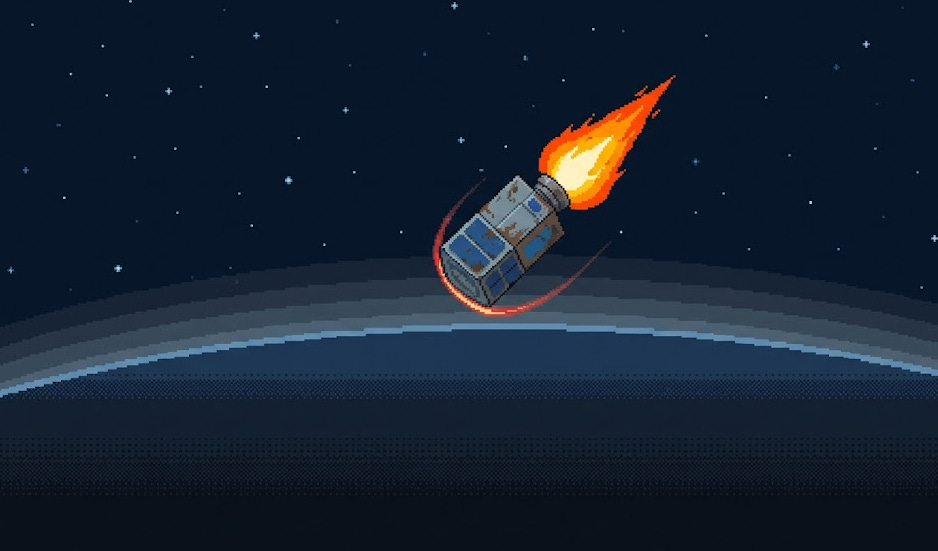
Somewhere over the South Pacific, a satellite that has worked faithfully for fifteen years receives its final command. It points itself backward and fires its engine one last time — not to climb or to dodge, but to slow down just enough to fall. Minutes later it slams into the upper atmosphere at 28,000 km/h, glowing white-hot, shedding panels and antennas, until what little survives splashes down in the emptiest patch of ocean on Earth — a place so remote the nearest humans are astronauts passing overhead. This is the story of how a satellite moves through space, how it dodges disaster, why it needs permission to fly at all, and how it dies. From zero.
The One Sentence That Explains Everything
A satellite’s entire life runs on a single, finite budget — not money, but speed.
Every move it makes — climbing to its orbit, holding its position against the forces trying to drag it down, dodging a piece of debris, and finally diving home to burn up — spends from the same limited tank of propellant. When that tank runs dry, the satellite can no longer fight, no longer steer, no longer save itself. A satellite is born with a fixed amount of “go,” and the day it runs out is the day it begins to die.
Everything else in this post is the detail behind that one idea: how the “go” works, what it’s spent on, and where satellites end up when it’s gone.
satellite controlled reentry deorbit burnYou Don’t Steer a Satellite, You Change Its Orbit
The first thing to unlearn: there is no steering wheel in space. A satellite doesn’t turn left or hit the gas the way a car does. To understand why, remember what an orbit actually is (from the previous post on finding your way in space): a satellite isn’t flying, it’s falling — moving sideways so fast that it keeps missing the Earth. Its path is set entirely by its speed and direction at any given moment.
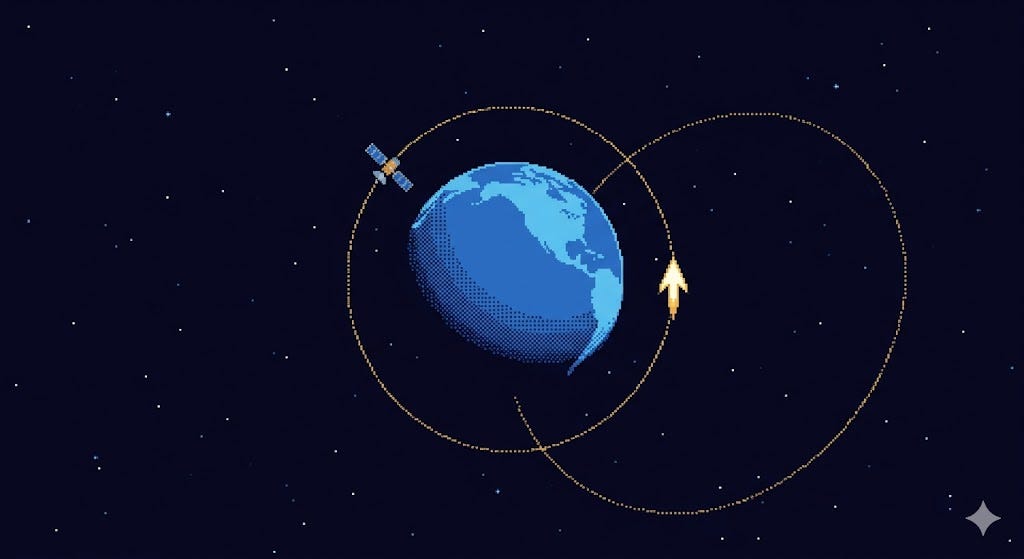
So the only way to move a satellite somewhere new is to change its speed. Speed it up and your orbit swells outward into a bigger loop. Slow it down and your orbit shrinks inward. Give it a sideways shove and you tilt the whole loop. There’s no friction to coast against and nothing to push off of — so every change of course is a deliberate, measured kick of velocity.
That’s the mental shift: a satellite navigates not by turning, but by carefully spending little bursts of speed change. And those bursts aren’t free — each one costs propellant. Which brings us to the most important number in all of spaceflight.
Delta-v: The Currency of Space
Engineers have a word for that budget of “go”: delta-v (written Δv, meaning “change in velocity”). It’s the total amount of speed change a satellite can produce over its whole life with the propellant it carries. Every maneuver has a price tag measured in delta-v, and the satellite spends from a fixed wallet.
How big is the wallet? It’s governed by one elegant equation — the Tsiolkovsky rocket equation, written down in 1903:

Don’t let it scare you. In plain words it says: your speed budget depends on two things — how efficient your engine is (Isp), and how much of your satellite is fuel versus everything else (the mass ratio: full mass m₀ divided by empty mass m_f). The “ln” is a natural logarithm, and its presence delivers a harsh truth: to get twice the delta-v, you don’t need twice the fuel — you need exponentially more. Wanting a lot of maneuvering ability means carrying a satellite that is mostly propellant tank.
The practical consequence is everything: fuel equals lifespan. A geostationary satellite might carry 15 years of delta-v for holding its position. When that propellant is spent, the satellite is still perfectly healthy — working radios, charged batteries, good computers — but it can no longer hold station or save itself. It’s out of “go.” That, more than any broken part, is what usually kills a satellite.

How You Push in a Vacuum
Here’s a puzzle: in space there’s nothing to push against — no road, no air, no water. So how does an engine move anything at all?
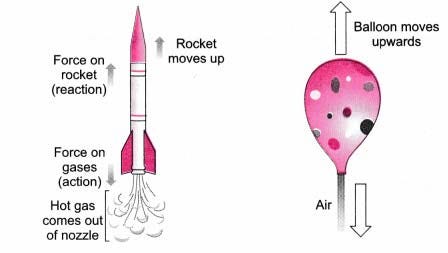
The answer is Newton’s third law: every action has an equal and opposite reaction. If you throw something backward, you get pushed forward — exactly like a skateboarder throwing a heavy ball and rolling away in recoil. A rocket engine does precisely this, just very fast and continuously: it hurls mass (hot gas, or charged particles) out the back, and the satellite recoils forward. Since there’s nothing external to push on, a satellite must carry its own stuff to throw — that’s what “propellant” really is. Not fuel to burn for energy, but mass to throw overboard.
This reveals what makes an engine “good.” Two different things matter:
Thrust — how hard it pushes right now (how much mass, how fast, out the back this second).
Efficiency — how much push you extract from each kilogram of propellant you brought. Engineers measure this as specific impulse (Isp), basically the “miles per gallon” of a rocket. Higher Isp means you wring more delta-v out of less propellant.
These two pull against each other, and the history of propulsion is the story of trading between them. Early satellites used crude, low-efficiency cold gas (literally a puff of pressurized gas) and chemical engines (high thrust, thirsty). Then came the electric-propulsion era: NASA’s Deep Space 1 (1998) flew the first ion engine on an interplanetary mission, and Europe’s SMART-1 (2003) sipped so little propellant it slowly spiralled all the way to the Moon on a thruster you could hold in your hands. Let’s look at the full menu.
The Propulsion Menu
A satellite’s engine is chosen by trading thrust against efficiency — like choosing between a drag racer and a hyper-mileage commuter car. Here’s the working set:
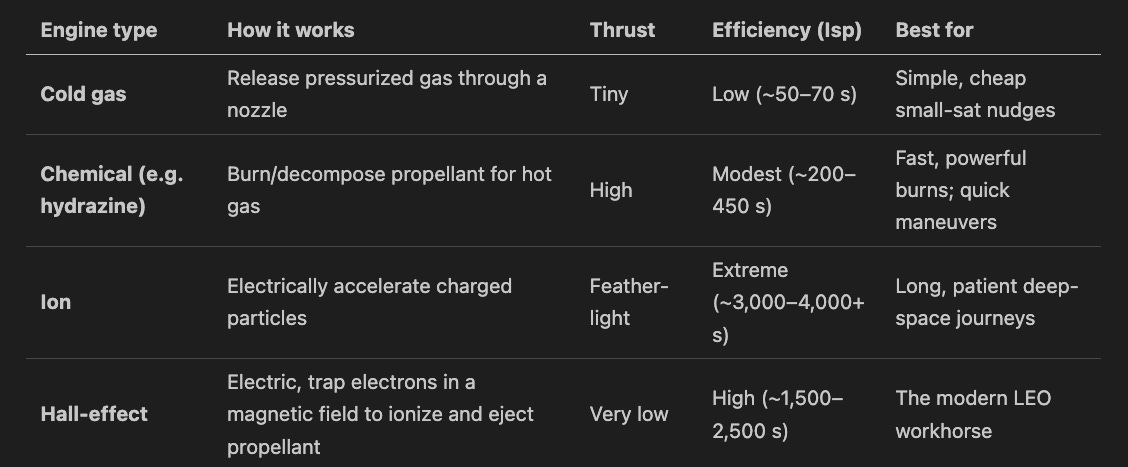
The key tradeoff jumps out of the table: chemical engines push hard but drink propellant; electric engines sip propellant but push so gently it can take months to change orbit. A chemical thruster can shove a satellite in seconds; an ion engine produces about the force of a sheet of paper resting on your hand — but it can run for years, and that patience adds up to enormous total delta-v.
The real-world poster child is Starlink: every satellite carries a Hall-effect thruster to raise itself to its operating altitude, hold station, and dodge debris. Early Starlinks used krypton as propellant; the newer V2 satellites switched to argon (cheaper and more abundant). Nearly ten thousand of these little electric engines are quietly humming in orbit right now — the largest fleet of thrusters in history.
But here’s the surprising flip side: most small satellites carry no engine at all. Over 80% of CubeSats launch without any propulsion — they can’t dodge debris, can’t fight drag, and can’t deorbit themselves on purpose; they simply ride the orbit they were dropped into until the atmosphere claims them. As orbits fill up and disposal rules tighten, that’s becoming untenable — which is why a wave of new companies (including our own work at Player One Space on a water-plasma pulsed thruster) is racing to give the smallest spacecraft a safe, affordable engine. Water is an appealing propellant precisely because of everything this post covers: it’s non-toxic, stored unpressurized, and rideshare-friendly — no hydrazine handling, no high-pressure tank sitting next to someone else’s satellite.

What Satellites Actually Do With That Fuel
So where does all that delta-v go? A satellite spends its budget on a handful of recurring jobs:
Orbit raising. Rockets usually drop satellites off in a low “parking” orbit. The satellite then fires its own engine to climb to its real operating altitude. For an electric-propulsion satellite this can be a months-long, gentle spiral upward.
Station-keeping — the biggest lifelong expense. An orbit is never left in peace: the thin upper atmosphere creates drag, the Moon and Sun tug on it, and the Earth itself isn’t a perfect sphere (it’s slightly lumpy, which nudges satellites off course). Left alone, a satellite slowly drifts out of position and, in low orbit, eventually falls. So it makes constant tiny correcting burns to stay exactly where it belongs — like a swimmer treading water against a current. This quiet, endless fight consumes most of a satellite’s propellant over its life.
Catching up and rendezvous — and here’s a delicious paradox covered in the navigation post: to catch up to something just ahead of you in orbit, you do not speed up. Firing forward raises your orbit, lengthens your lap time, and makes you fall behind. To catch up, you fire backward, dropping into a lower, faster orbit to close the gap. Orbital motion is gloriously counterintuitive.
Plane changes — the most expensive maneuver of all. Tilting your orbit to a different angle (say, from equatorial to polar) means fighting your entire orbital speed sideways. It can cost more delta-v than reaching orbit in the first place, which is why satellites are launched into the right orbital plane rather than changing it later.
The deorbit burn — the final expense, saved for the very end: one last burn to drop out of orbit on purpose. More on that soon.
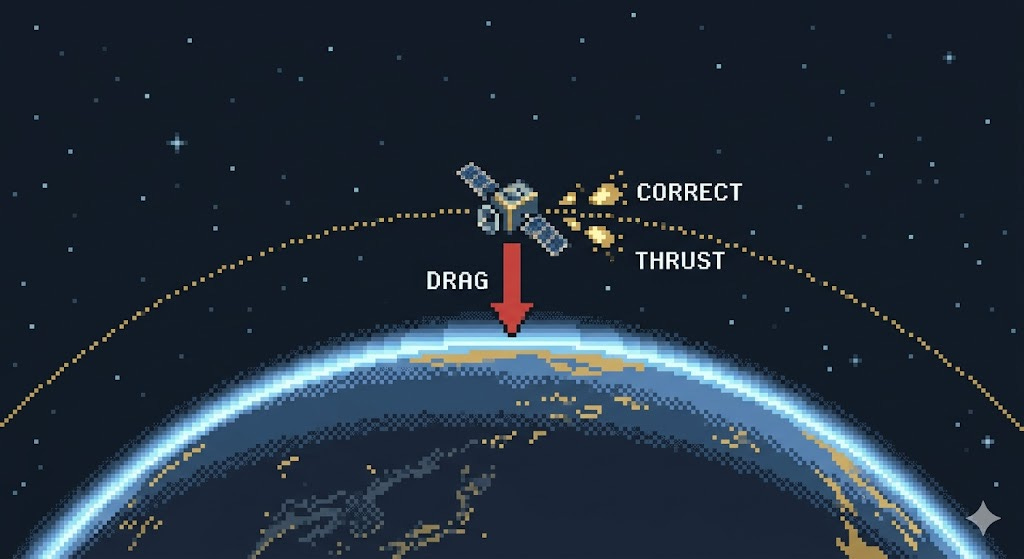
The Traffic Problem: Space Is Huge, but Filling Up
Before we follow a satellite to its grave, we have to talk about the danger it spends its whole life dodging: everything else up there.
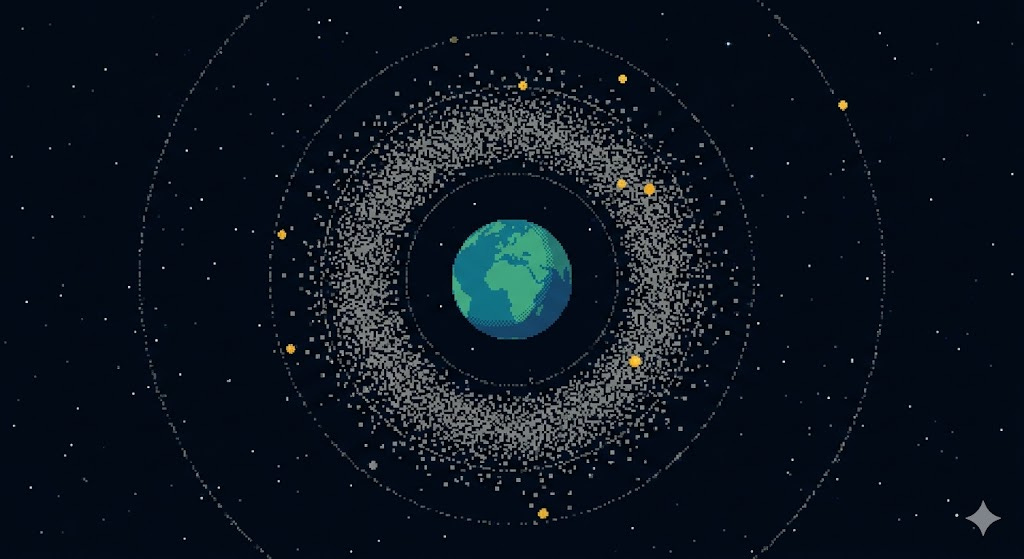
Low Earth orbit is getting crowded — and not just with working satellites. Decades of launches, dead spacecraft, spent rocket stages, and shattered fragments have filled the most useful orbits with junk. The numbers (as of 2026) are sobering:
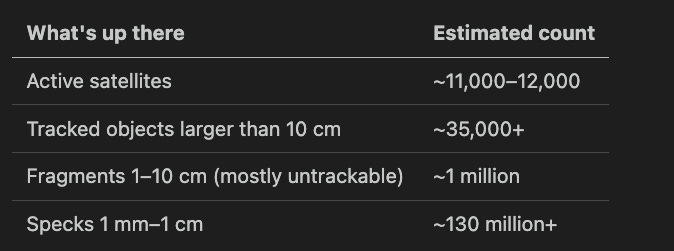
And it’s not the size that’s terrifying — it’s the speed. Objects in low orbit move at roughly 7.8 km/s, and two of them on crossing paths can meet at a closing speed of 10–15 km/s (about 10× faster than a rifle bullet). At those velocities, a fleck of debris just 1 cm across hits with the energy of a hand grenade, and a 10 cm bolt can obliterate an entire satellite. Worse, anything smaller than about 10 cm is too small to track from the ground — present, lethal, and invisible.
Some orbital “shells” are far worse than others:
400–500 km (the ISS zone): relatively self-cleaning — air drag drags junk down within years.
500–600 km: the densest active traffic (Starlink, Kuiper); debris here clears in ~25 years.
700–900 km: the worst existing debris band; junk lingers for decades to centuries.
1,000–1,200 km: any mess here is essentially permanent.
We know it’s dangerous because it has already happened. China’s 2007 anti-satellite missile test shattered its own Fengyun-1C satellite at 865 km, adding 3,000+ trackable fragments and bloating the global debris catalog by a quarter. In 2009 a dead Russian satellite, Cosmos 2251, slammed into the working Iridium 33 at 11.7 km/s — the first accidental collision of two intact satellites. And in 2021, Russia’s Cosmos 1408 ASAT test forced the ISS crew to shelter. Each event scattered thousands of new bullets into orbit.
This is the nightmare scenario scientists Donald Kessler and Burton Cour-Palais described back in 1978: the Kessler Syndrome, where collisions create debris that causes more collisions, in a cascade that could one day make whole orbits unusable. Which raises the obvious question…
So Why Don’t They All Crash?
If orbit is so crowded and the speeds so deadly, why don’t we hear about collisions every day? Three reasons work together.
Space is genuinely vast. This is the most underrated answer. Even ~10,000 satellites are spread across a shell that stretches around the entire planet and hundreds of kilometers thick — a volume of trillions of cubic kilometers. On average, satellites are hundreds of kilometers apart. And orbits aren’t random chaos; they’re carefully organized into planned altitudes and planes, like floors in a parking garage. Most of the time, “crowded” still means “mostly empty.”
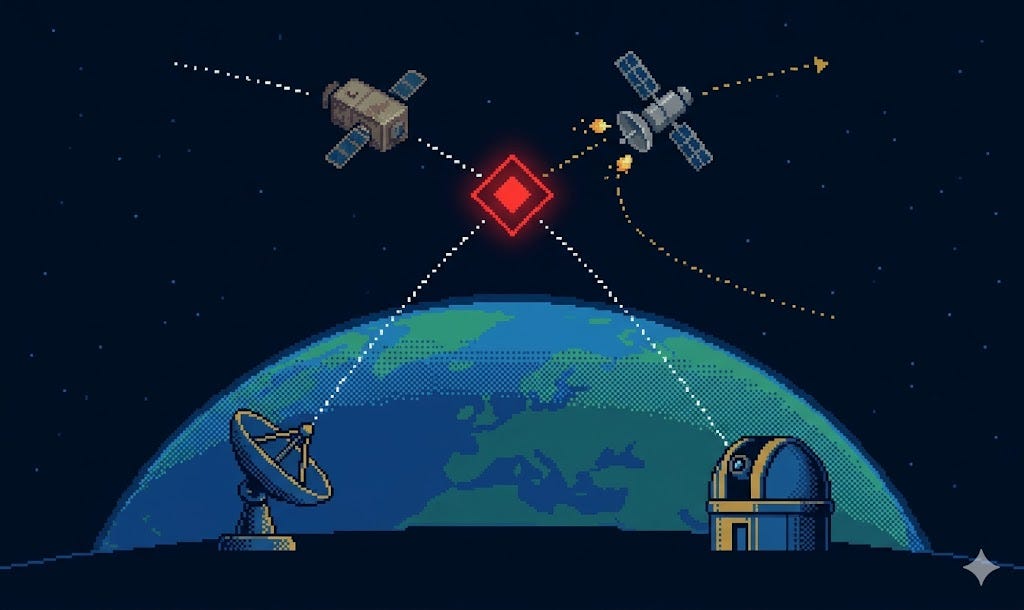
Everything big is tracked. A global watch keeps a catalog of every object larger than about 10 cm. The US Space Force’s 18th and 19th Space Defense Squadrons run the master catalog (shared publicly via Space-Track.org), and a growing commercial industry sharpens the picture — LeoLabs with a worldwide network of radars, Slingshot Aerospace with optical telescopes. Together they function as the air-traffic control of orbit, predicting where every tracked object will be.
Operators get warned, and they move. When two objects are predicted to pass dangerously close, operators receive a Conjunction Data Message (CDM) — a formal “heads-up, you two might collide.” Each warning comes with a calculated probability of collision, and a common rule of thumb is: if that probability climbs above roughly 1 in 10,000, you maneuver out of the way. A small burn hours ahead of time turns a near-miss into a comfortable gap. Starlink alone processes thousands of these warnings every week and dodges autonomously — its satellites decide and maneuver without a human in the loop.
Tracking finds the threat; a little delta-v dodges it. That’s the system that keeps orbit working. But it has a gap — and the ISS shows how we handle it.
Why the ISS Doesn’t Get Hit
The International Space Station — the most precious object in orbit, with humans aboard — is the best illustration of the whole defense system in action. It survives by layering three tactics:
Dodge the big stuff. When trackers predict a close approach, the ISS fires its thrusters (or its docked vehicles’ thrusters) to shift its orbit out of harm’s way. It has performed roughly 40 of these debris-avoidance maneuvers since 1998 — a few every year.
Hide from the surprises. Sometimes a threat is spotted too late to maneuver. In that case the crew shelters in their docked spacecraft (the Soyuz or Dragon capsules that brought them up), sealing themselves into their “lifeboats” until the object passes — ready to undock and flee home if the worst happens.
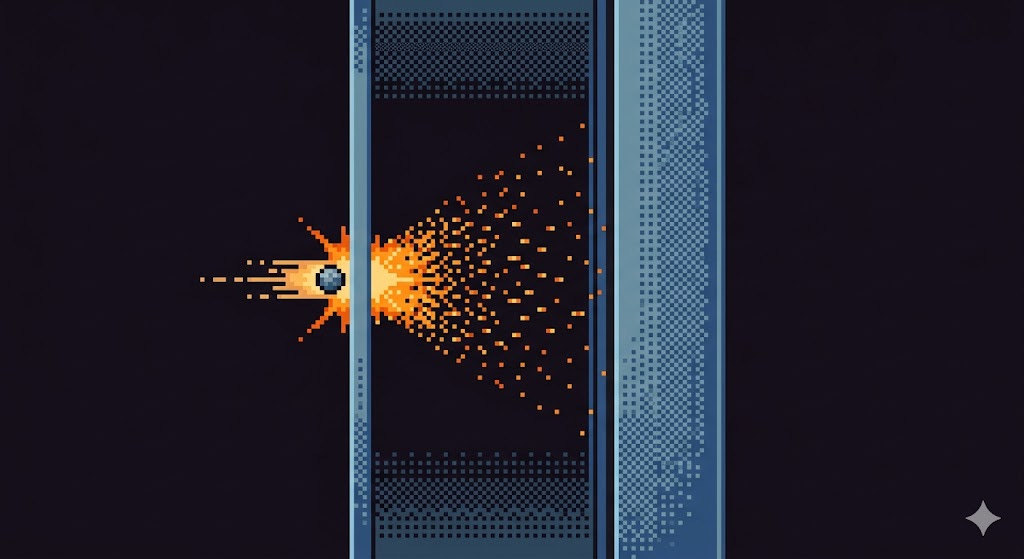
Armor against the invisible. For the untrackable specks smaller than ~1 cm that you cannot dodge, the station wears armor: the Whipple shield, invented by astronomer Fred Whipple in the 1940s. It’s deceptively simple — a thin outer “bumper” plate held a gap away from the real hull. A hypervelocity fleck hits the bumper and shatters and vaporizes itself, so that only a harmless spray of dust — not a solid bullet — reaches the wall behind it. The ISS carries over a hundred enhanced shields stuffed with ceramic and Kevlar.
Notice the strategy: tracking handles the big objects, shields handle the tiny ones — and the scary gap is the middle, the 1–10 cm fragments too small to track but too big for any shield to stop. That gap is precisely why keeping orbit clean matters so much.
Permission to Fly: Who Lets You Launch a Satellite?
Here’s something many people don’t realize: you can’t just build a satellite and launch it. Space is regulated, and getting a spacecraft to orbit legally means collecting a stack of permissions first. In the United States, for example:
A radio license (FCC). Almost every satellite transmits radio signals, and you can’t use the airwaves without authorization. This is the big one — and it’s where the regulator checks your whole plan.
Spectrum and orbital-slot coordination (ITU). Internationally, the International Telecommunication Union coordinates who broadcasts on which frequencies and (for high orbits) who parks in which slot, so satellites don’t jam each other.
An imaging license (NOAA). If your satellite photographs the Earth, you need a separate commercial remote-sensing license.
A launch license (FAA). The rocket itself needs approval to fly.
Plus your own national space regulator, depending on the country.
Crucially, modern licenses now demand an end-of-life plan before you’re allowed up. You must show a credible deorbit plan (how you’ll remove the satellite when it’s done) and commit to passivation — venting all leftover fuel and draining batteries at the end so your dead satellite can’t later explode into a cloud of debris. Permission to launch is now tied to a promise to clean up.
Does all this apply to tiny CubeSats and “pocketsats”? Absolutely — size is no exemption. A satellite the size of a loaf of bread, or even a deck of cards, needs the same authorizations. And the most famous lesson in the industry proves it: in 2018 the FCC fined a startup called Swarm Technologies $900,000 for launching four “SpaceBEE” picosatellites — each just 0.25U, about the size of a sandwich — on an Indian rocket without authorization. The FCC had specifically denied their application beforehand, partly because the satellites were judged too small to be reliably tracked from the ground — exactly the “invisible debris” risk that keeps regulators up at night. Swarm launched anyway, and paid for it. The message to the whole industry was clear: no satellite is too small to follow the rules.

The Good Death: How a Satellite Is Disposed Of
Eventually every satellite’s mission ends — fuel runs low, hardware ages, or newer technology makes it obsolete. A responsible operator doesn’t just abandon it as a hazard. There are two proper ways to die, and which one you get depends entirely on how high you are.
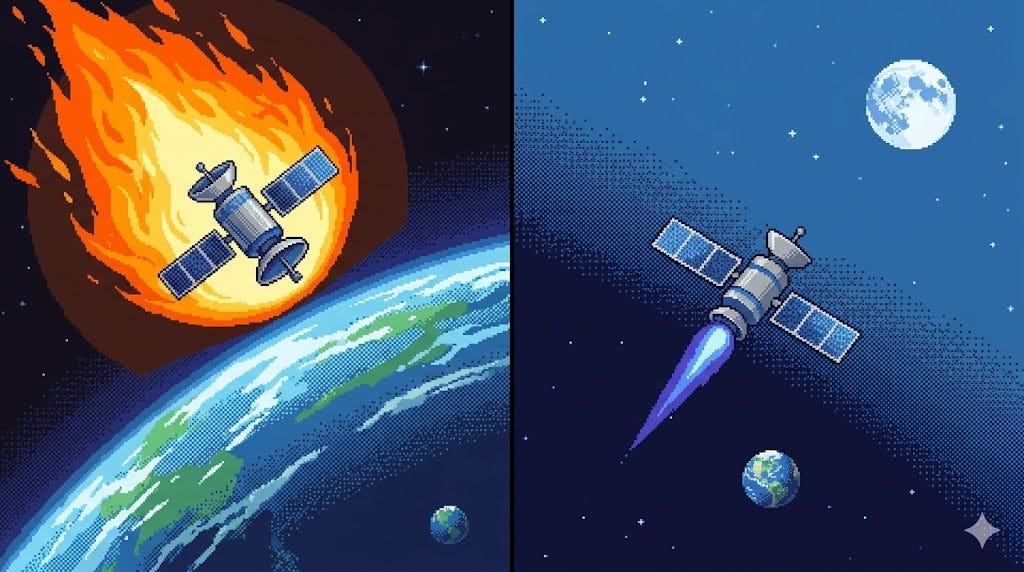
Low orbit → the fiery reentry. Down low, you spend your last delta-v on a deorbit burn that drops the satellite into the thin upper atmosphere — where it slams into air at orbital speed, heats to thousands of degrees, and burns up in a streak of fire. (Below about 500 km, atmospheric drag will eventually drag a dead satellite down on its own — no burn needed.) For years the guideline was to clear out within 25 years of mission’s end, but in 2022 the FCC tightened it dramatically to a 5-year rule for satellites it licenses. Engineers even practice “design for demise“ — deliberately building satellites so that every part fully burns up and nothing dangerous reaches the ground.
High orbit → the graveyard. A geostationary satellite sits at 35,786 km — far too high to drop into the atmosphere; the delta-v to come home from there would be enormous. So instead, near end of life, GEO satellites spend a small final budget to boost themselves about 300 km higher, into a designated “graveyard orbit” above the busy belt (an international IADC guideline), then passivate and go silent. They never come home — they just retire to a quiet parking lot in the sky, drifting forever.
But what about the big low-orbit satellites whose parts don’t fully burn up? They get the most dramatic ending of all.
The Satellite Graveyard in the Ocean: Point Nemo
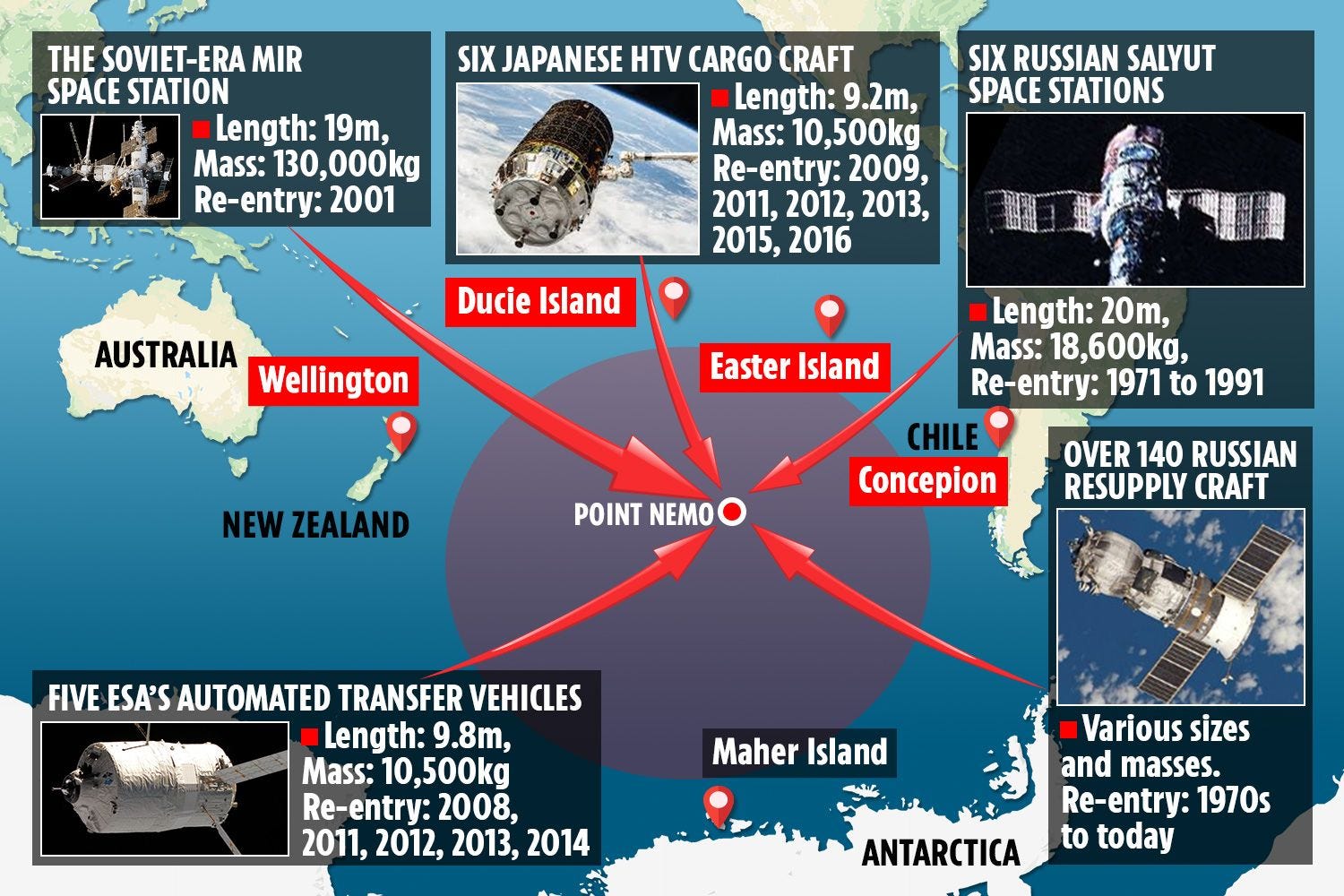
Big, dense satellites — and especially space stations — don’t burn up completely. Chunks of titanium and steel (fuel tanks, reaction wheels, dense structural parts) can survive the inferno of reentry all the way to the surface. Since the global safety standard demands that the risk of a reentry hurting anyone on the ground stays below 1 in 10,000, you can’t let those survivors fall just anywhere. You aim them at the emptiest place on the entire planet.
That place has a name: Point Nemo — the “oceanic pole of inaccessibility,” at roughly 48°52′S 123°23′W in the remote South Pacific. It is the single spot on Earth farthest from any land in every direction; the nearest people are often the astronauts on the ISS passing 400 km overhead, closer than any coastline. Because nothing and no one is there, it became the world’s spacecraft cemetery.
Somewhere between 260 and 300+ spacecraft now rest on the seabed beneath Point Nemo — defunct satellites, cargo ships, and spent stages, deliberately steered to splash down there. Its most famous resident is Russia’s Mir space station, guided to a fiery, controlled reentry over the Pacific on March 23, 2001.
And the cemetery is about to receive its largest occupant ever. When the International Space Station is retired around 2030–2031, it will be deorbited to Point Nemo — a structure the size of a football field, far too massive to risk an uncontrolled fall. To do it, NASA selected SpaceX in 2024 to build a purpose-made “US Deorbit Vehicle” — a beefed-up Dragon capsule packed with extra thrusters and propellant — under a contract worth up to $843 million, whose only job is to grab the station and aim humanity’s greatest orbital outpost at that lonely patch of ocean.
Cleaning Up: The Future of Orbital Housekeeping
Here’s the catch with all these disposal rules: they only slow the creation of new junk. They do nothing about the 35,000+ pieces already up there — the dead satellites and spent rockets that will keep colliding and fragmenting for centuries. ESA’s models deliver a stark verdict: just to stabilize the worst orbital bands, we’d need to actively remove about five large objects every year — and right now we remove essentially zero.
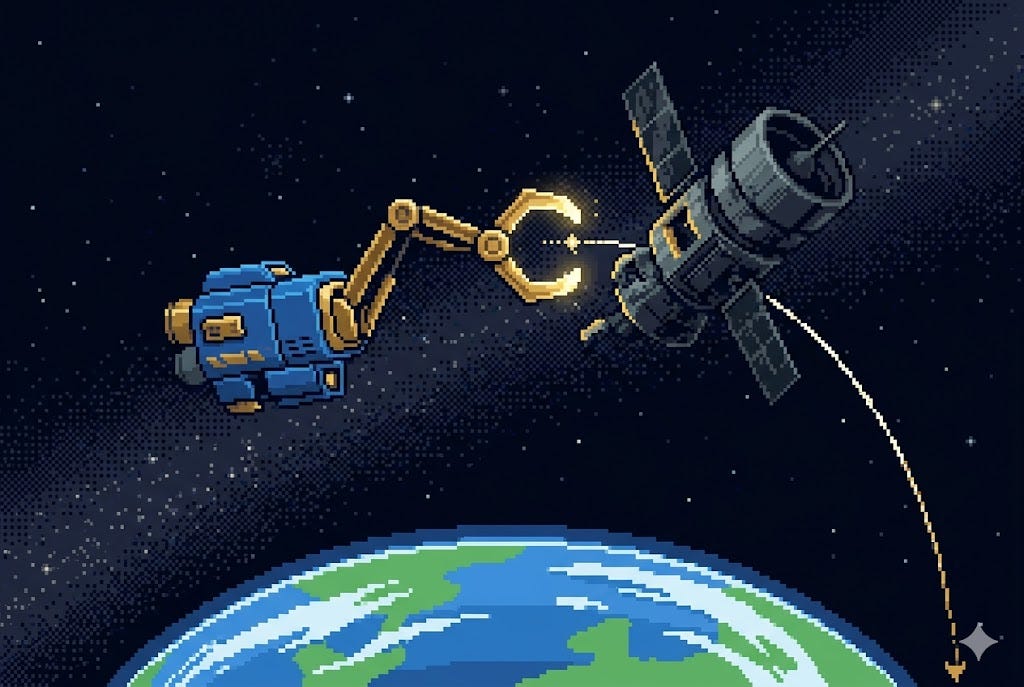
So a new industry is being born: active debris removal (ADR) — spacecraft that chase down dead objects and drag them out of orbit. The pioneers are flying:
ClearSpace-1 (Switzerland/ESA) — originally contracted to capture a ~112 kg leftover rocket adapter with a robotic arm. In a grim twist, that adapter was itself struck by debris in 2023 — the problem underlining its own cleanup mission — so the rescoped mission now targets ESA’s retired PROBA-1 satellite later this decade.
Astroscale (Japan/UK) — demonstrated magnetic capture with ELSA-d in 2021; its ELSA-M servicer aims to deorbit several client satellites per mission.
D-Orbit (Italy) — space tugs that deliver satellites and then responsibly remove themselves.
RemoveDEBRIS (UK) — back in 2018, actually tested catching debris with a net and a harpoon in orbit.
Starfish Space (USA) — its Otter servicer is already winning US Space Force contracts to deorbit satellites.
The frontier beyond cleanup is in-orbit refuelling — companies like Orbit Fab want to set up “gas stations” in space. Refilling a satellite’s delta-v changes everything: a debris-removal vehicle could top up and bag many targets instead of one, and satellites could be kept alive for decades instead of dying when the tank runs dry. Combine refuelable tugs with the AI-piloted rendezvous from the navigation post, and orbit stops being a one-way graveyard and becomes something we actually maintain.
Summary: A Satellite’s Whole Life in One Breath
You don’t steer in space — you change your orbit by changing your speed. Every maneuver is a measured kick of velocity.
Delta-v is the currency of space — a fixed budget of speed change set by the Tsiolkovsky equation. Fuel equals lifespan.
Engines push by throwing mass backward (Newton’s third law); they’re judged on thrust vs efficiency (specific impulse).
The propulsion menu trades the two: cold gas and chemical (high thrust, thirsty) vs ion and Hall-effect (sip propellant, push gently). Starlink runs the largest fleet of electric thrusters ever.
Satellites spend delta-v on orbit raising, lifelong station-keeping against drag, rendezvous (with the catch-up paradox), costly plane changes, and the final deorbit burn.
Orbit is crowded and lethal — tens of thousands of tracked objects, millions of untracked specks, closing at 10–15 km/s, with the Kessler cascade as the long-term fear.
They mostly don’t collide because space is vast, big objects are tracked (Space Force + LeoLabs + Slingshot), and operators dodge when collision odds top ~1 in 10,000.
The ISS survives by maneuvering (~40 times), sheltering the crew when it’s too late, and wearing Whipple shields against the specks it can’t dodge.
You need permission to fly — FCC, ITU, NOAA, FAA, and a mandatory deorbit-and-passivation plan — and it applies even to sandwich-sized picosats (just ask Swarm and its $900K fine).
Satellites die two ways: low ones burn up on reentry (now within 5 years); high ones retire to a graveyard orbit ~300 km above GEO.
The survivors splash down at Point Nemo, the remotest ocean on Earth — soon to receive the ISS itself, via a purpose-built SpaceX deorbit vehicle.
The future is housekeeping — active debris removal and in-orbit refuelling, turning orbit from a one-way graveyard into something we maintain.
A satellite is born with a fixed tank of “go.” It climbs, it holds its ground against the forces dragging it down, it dodges the debris trying to kill it — and when the tank finally runs dry, it takes the long fall home. How well we manage that whole arc, from launch permission to final splashdown, decides whether orbit stays usable for the next generation.
Up next: how satellites get to orbit in the first place — the story of rockets, rideshares, and the brutal climb uphill.
Published by Player One Space | dima@playeronespace.com