

The Problem: Satellites Are Drowning in Their Own Data

Modern satellites are extraordinary sensors. A single synthetic aperture radar (SAR) satellite can generate 2–5 terabytes of raw imagery per day. A hyperspectral imager captures hundreds of spectral bands per frame. A constellation of Earth observation satellites shooting at full resolution produces more data per hour than a hospital’s entire annual records.
There’s just one problem: you can’t downlink all of it.
Ground station contact windows are short — a typical LEO satellite has 5–10 minutes of contact per pass over a given station. Downlink bandwidth, even with laser optical communications, is improving at roughly 10× per decade. But sensor data volume is growing at 200× per decade.
The math doesn’t work.
On-orbit AI is the answer. Instead of sending raw data to the ground and processing it there, you process it on the satellite — and only send down what matters. AI reduces that 5 TB/day fire hose to a few hundred gigabytes of actionable intelligence. Latency drops from hours to minutes. Storage requirements collapse. And the satellite stops being a dumb pipe and starts being an intelligent edge node.
Use Cases: From Simple Filtering to Full AI in Orbit
Not all on-orbit compute is equal. Think of it as a ladder — each rung requires more processing power, more energy, and a bigger satellite. Here’s the full progression:
Tier 1 — Cloud Detection and Frame Filtering
Complexity: Low | Hardware needed: FPGA or microcontroller

The simplest and most universal application. About 66% of Earth’s surface is cloud-covered at any given moment. Without onboard filtering, an Earth observation satellite wastes most of its downlink quota transmitting white cloud images that are useless to customers. A lightweight neural network or even a classical computer vision algorithm runs on the satellite, detects cloud cover, and simply skips those frames. Only clear-sky imagery gets queued for downlink. Immediate ROI: fewer wasted passes, more useful data per megabyte downlinked.
Tier 2 — Image Compression and Normalization
Complexity: Low | Hardware needed: FPGA or low-power CPU
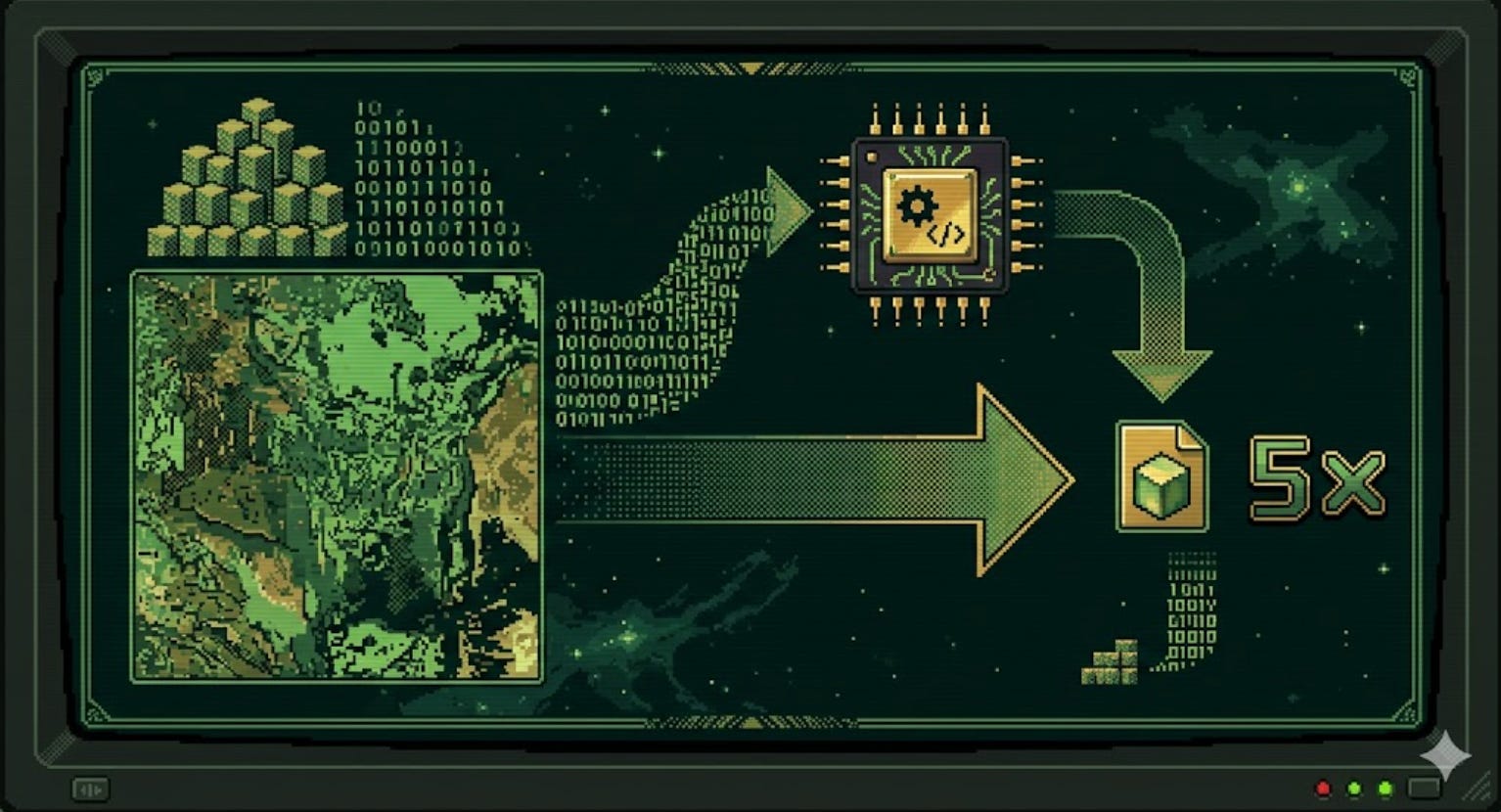
Neural image compression (replacing legacy JPEG-2000) can achieve 3–5× better compression at the same visual quality. Geometric correction, radiometric normalization, and band calibration can all run onboard, delivering analysis-ready data directly — no ground preprocessing required.
Tier 3 — Land-Cover Classification
Complexity: Medium | Hardware needed: Jetson Nano or Coral TPU
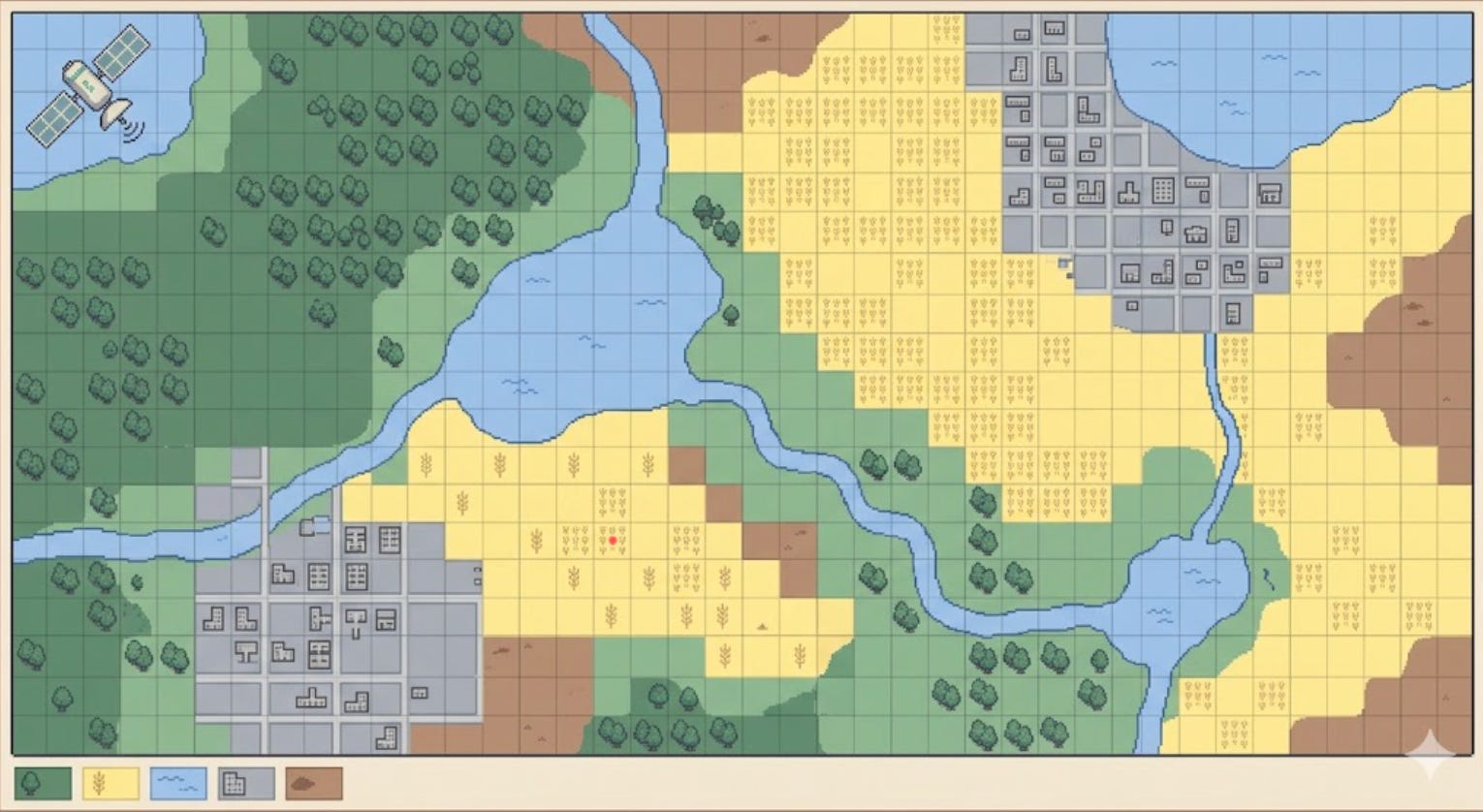
Convolutional neural networks (CNNs) classify each pixel of an image into categories — forest, urban, water, cropland, bare soil — with 92% overall accuracy in published benchmarks. Instead of downlinking a raw image, the satellite downlinks a classified map. Megabytes, not gigabytes. Applications: deforestation monitoring, urban expansion tracking, and agricultural land-use change.
Tier 4 — Change Detection
Complexity: Medium | Hardware needed: Jetson Nano or better
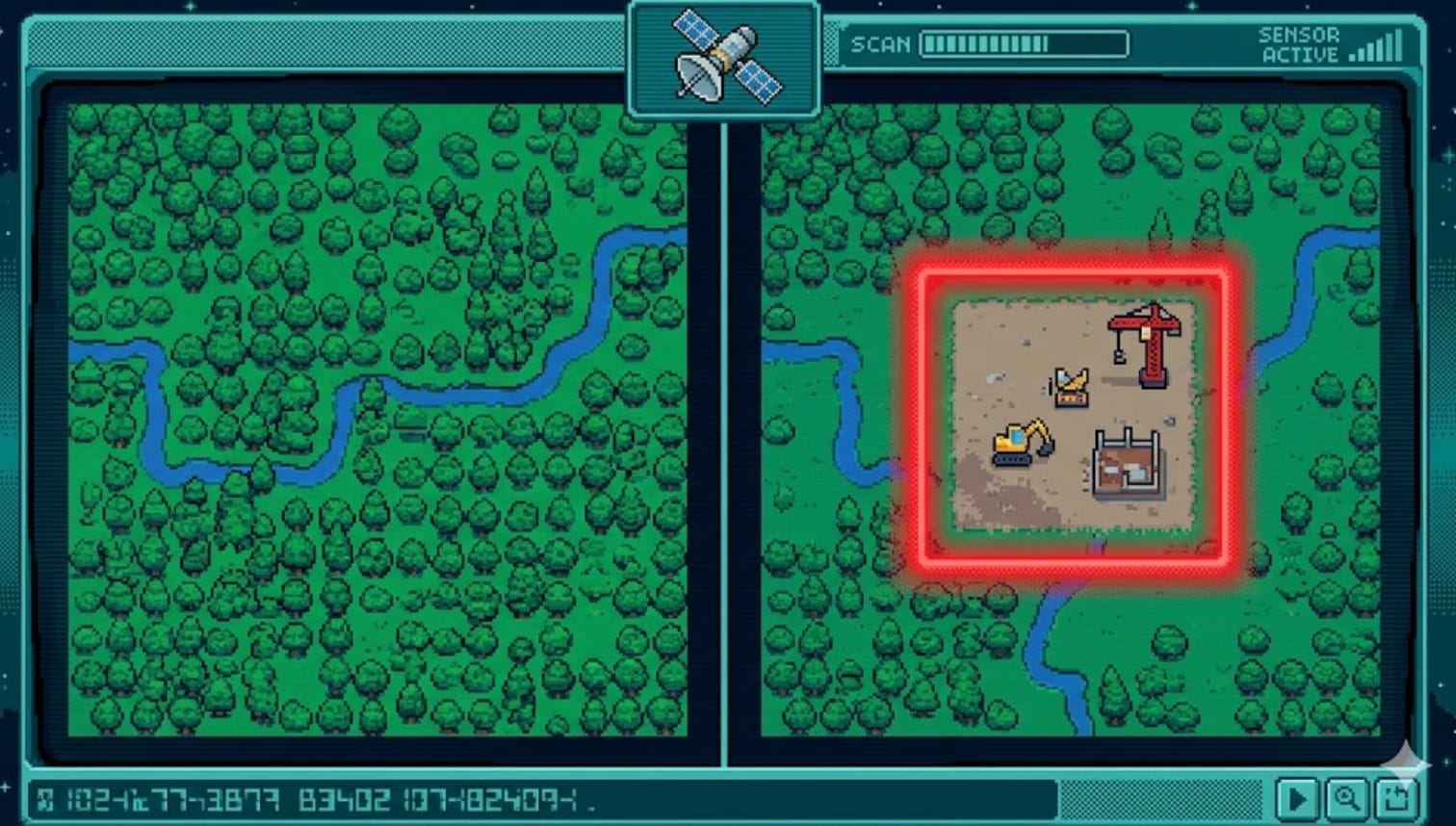
Compare today’s imagery to yesterday’s — or last month’s — and flag only what changed. A construction site appearing overnight. A forest patch that disappeared. A river changing course. 95% recall rates have been demonstrated with multitemporal CNN models. This is the foundation of environmental monitoring, infrastructure surveillance, and disaster response.
Tier 5 — Object Detection: Ships, Aircraft, Vehicles
Complexity: High | Hardware needed: Jetson Orin NX or Jetson AGX Orin
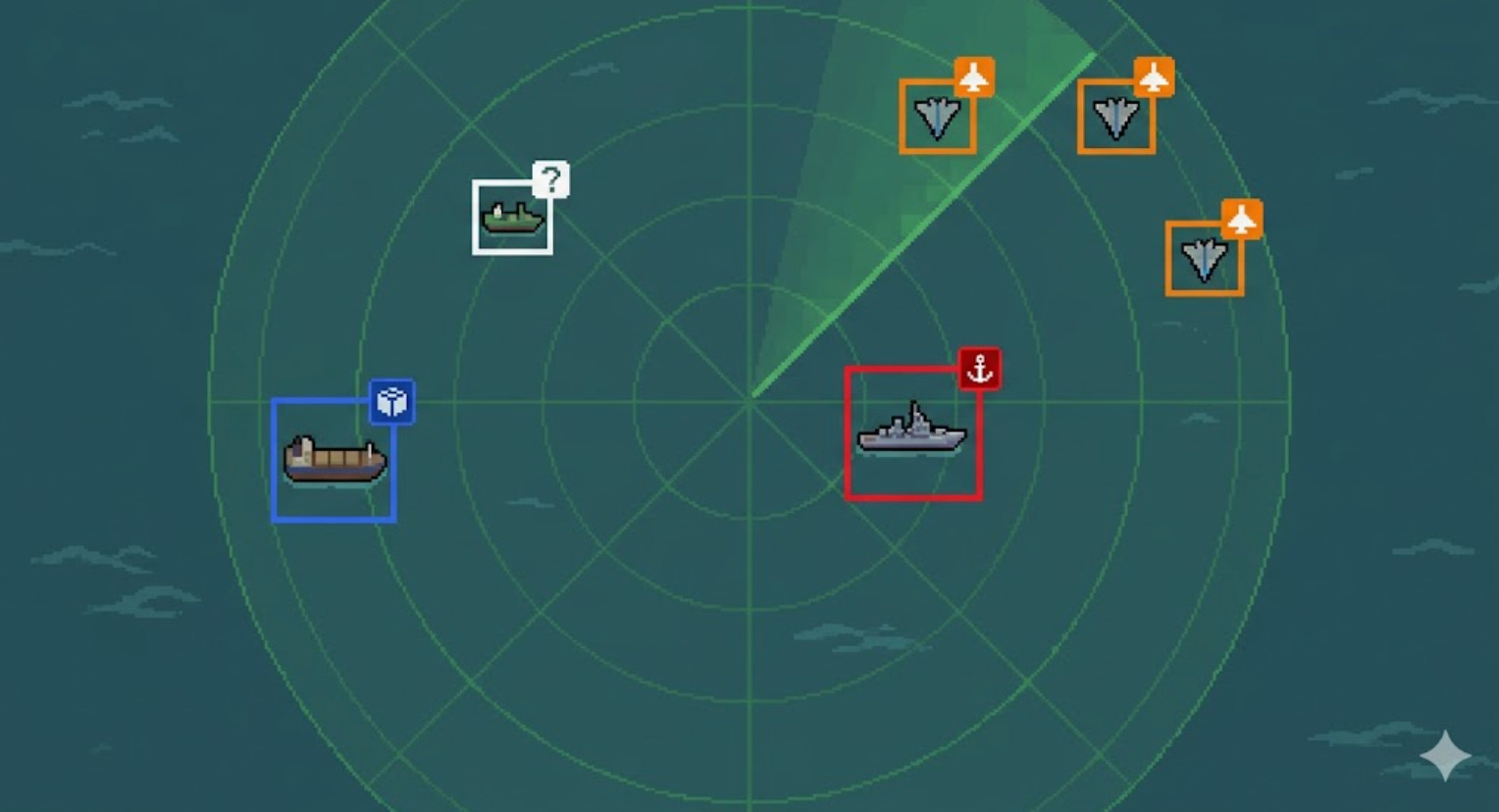
Move from pixel classification to object detection — find specific things in an image and label them. ICEYE, the Finnish SAR satellite company, demonstrated 30-second onboard classification of SAR radar returns into categories like bombers, transport aircraft, air defense systems, and surface ships. This capability is transforming defense and maritime intelligence — instead of analysts reviewing hours of radar data on the ground, the satellite itself tells you what it saw.
Tier 6 — Space Situational Awareness (SSA): Watching Other Objects in Orbit
Complexity: High | Hardware needed: Jetson AGX Orin or dedicated processor
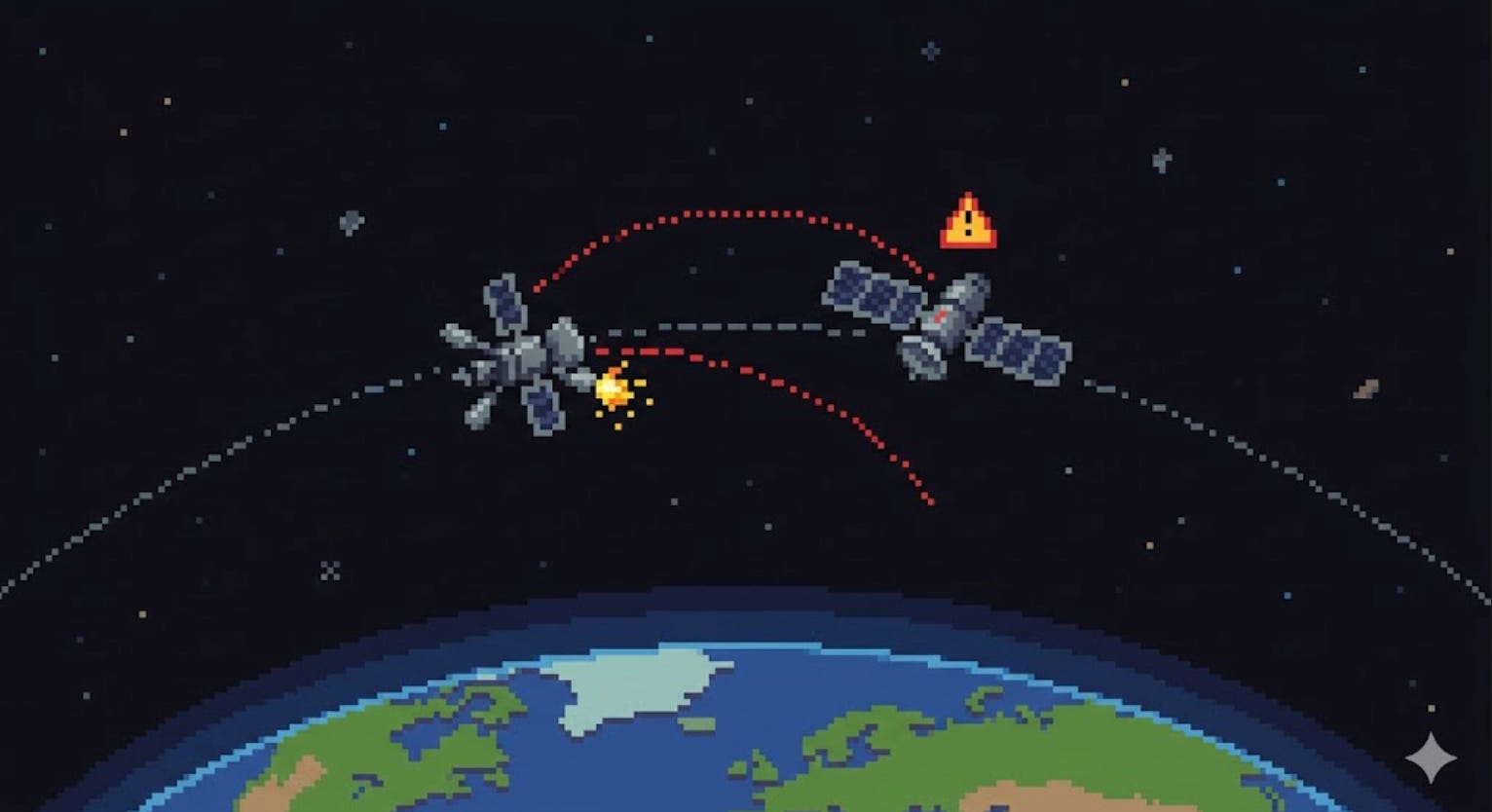
There are currently ~50,000 tracked objects in orbit — active satellites, dead satellites, rocket bodies, and debris fragments. Every object is a potential collision. Traditional SSA relies on ground-based radar networks that track objects and upload conjunction warnings to satellite operators, who then decide whether to maneuver. That loop takes hours.
Onboard AI changes the equation. A satellite equipped with a star tracker or space telescope payload can autonomously:
Monitor proximity of nearby objects in real time
Calculate conjunction probability using onboard orbital mechanics models
Autonomously command a small thruster burn to avoid collision — without waiting for a ground uplink
Companies like LeoLabs, Slingshot Aerospace, and ExoAnalytic Solutions are building AI-powered SSA ground networks today. The next step is moving that intelligence onto the satellite itself, enabling autonomous collision avoidance at orbital speed — where the decision window is sometimes measured in minutes, not hours.
Future vision: constellations that self-coordinate collision avoidance peer-to-peer via inter-satellite links, with no ground involvement at all.
Tier 7 — Ballistic Missile Detection and Trajectory Prediction
Complexity: High | Hardware needed: Radiation-hardened AI processor, large satellite
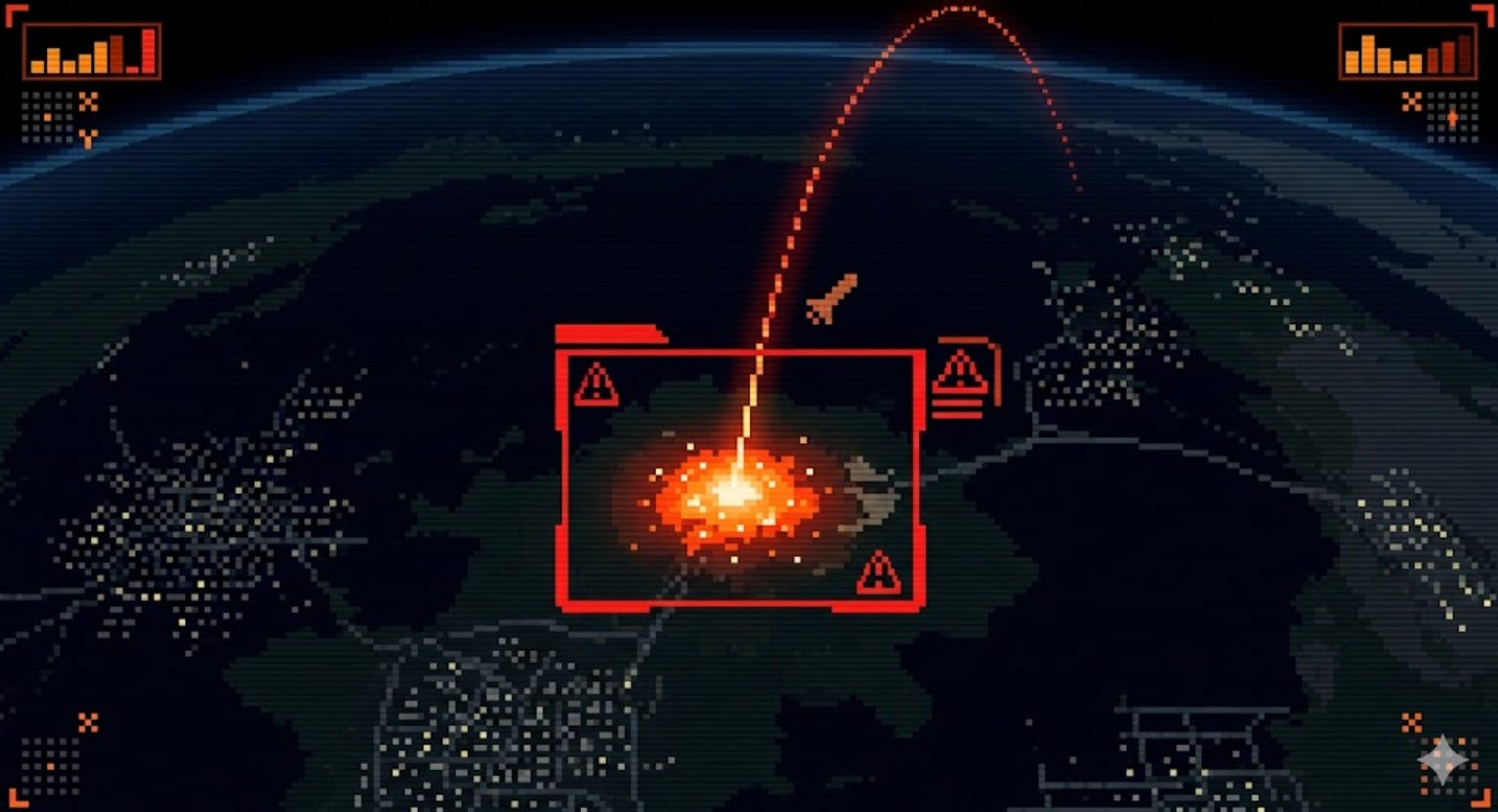
This is where on-orbit AI intersects directly with national security. The US Space-Based Infrared System (SBIRS) and its successor the Next-Generation OPIR program use infrared sensors in GEO and HEO orbits to detect the heat bloom of a missile launch within seconds of ignition.
Traditional systems use rule-based detection — look for a bright infrared signature matching a known launch pattern. On-orbit AI upgrades this dramatically:
Classification: Is this a ballistic missile, a space launch vehicle, or a false positive (wildfire, industrial explosion)? ML models trained on thousands of launch signatures can distinguish these in milliseconds.
Trajectory prediction: Given the launch vector and burn characteristics, compute the likely target region and impact time — before the missile leaves the atmosphere.
Intercept window calculation: Relay actionable targeting data to ground-based interceptor systems in near real-time.
The US DoD is actively investing in this transition — from rule-based to ML-based missile warning — because AI dramatically reduces false alarms while improving detection confidence. Every second saved in the decision chain matters when the incoming flight time is 20–30 minutes.
Tier 8 — Asteroid, Meteor, and Near-Earth Object (NEO) Tracking
Complexity: High | Hardware needed: Large satellite or space telescope
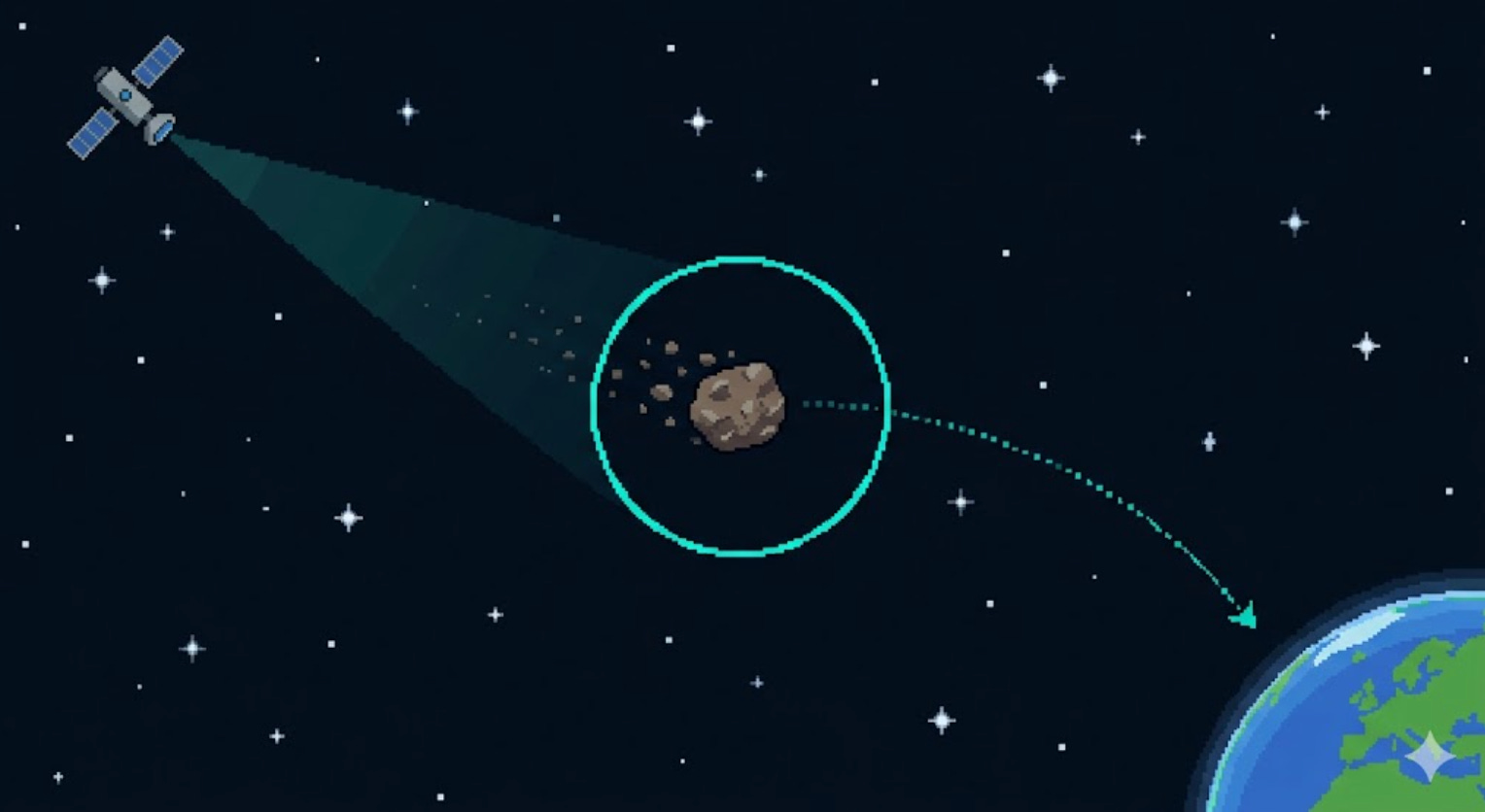
Earth is constantly bombarded — most of it harmlessly, but ~2,000 potentially hazardous asteroids are known to exist in near-Earth space, and many more are undiscovered. Ground-based telescope networks like Pan-STARRS and Catalina Sky Survey scan the sky nightly. The problem: clouds, daylight, and atmosphere all limit ground coverage.
Space-based AI telescopes change this:
Continuous 24/7 sky survey from orbit — no clouds, no atmosphere
Onboard AI distinguishes moving objects (asteroids, meteors) from background stars in real time
Calculates orbital parameters and impact probability autonomously
Flags high-priority objects for immediate downlink and ground follow-up
NASA’s NEO Surveyor (launched 2028, infrared space telescope) and ESA’s Hera mission both incorporate autonomous AI navigation and object classification. The vision: a distributed constellation of small AI-equipped space telescopes doing collaborative sky surveys — covering more sky, faster, and cheaper than any single large observatory.
Space weather is the other dimension here. Solar flares and coronal mass ejections (CMEs) can disrupt satellite electronics, GPS signals, and power grids on Earth. On-orbit AI can detect and classify solar events from satellite sensor data, generating automated alerts minutes before the effects reach Earth — critical for protecting infrastructure.
Tier 9 — Full ML Inference Pipeline
Complexity: Very High | Hardware needed: H100-class GPU, large satellite

Full end-to-end ML pipelines running onboard: hyperspectral image analysis across hundreds of spectral bands, multi-sensor fusion (optical + SAR + thermal + infrared), real-time disaster damage assessment, precision agriculture crop stress detection, and methane/carbon emission quantification from industrial sites.
Pixxel’s Pathfinder satellite (200 kg, launching Q4 2026) carries datacenter-grade GPUs and a partnership with Sarvam AI to run foundation models for hyperspectral Earth intelligence onboard. This isn’t just processing an image — it’s running a trained model that understands what the image means.
Tier 10 — Large Language Models and Generative AI in Orbit
Complexity: Cutting Edge | Hardware needed: NVIDIA Vera Rubin Space-1 or equivalent

The frontier: running LLMs, foundation models, and generative AI directly in orbit. VAST Space is building a 15 kW-class satellite bus specifically designed to host NVIDIA’s Space-1 Vera Rubin Module — delivering 25× more AI compute than an H100 for space-based inferencing, with two Rubin GPUs, a Vera CPU, and 1.2 TB/s memory bandwidth. First launch: 2027.
What do you run on an orbital LLM? Autonomous decision-making for complex multi-sensor missions. Natural language tasking interfaces where operators simply say “monitor this region for unusual military activity” and the satellite interprets, plans, and executes. Synthetic data generation for model retraining in orbit.
The Hardware: What Actually Runs AI in Space
Radiation-Hardened CPUs — The Reliable Workhorse
Before AI accelerators, satellites ran on radiation-hardened processors — chips designed to survive the constant bombardment of cosmic rays and energetic protons in space. These aren’t fast. They’re reliable.
BAE Systems RAD750 is the gold standard: 110–200 MHz, 5W power consumption, survives up to 1,000,000 rads of total ionizing dose. It flies on the Mars Curiosity and Perseverance rovers, the New Horizons probe to Pluto, and hundreds of military satellites. Slow by modern standards (about the speed of a 1990s desktop PC), but nearly indestructible.
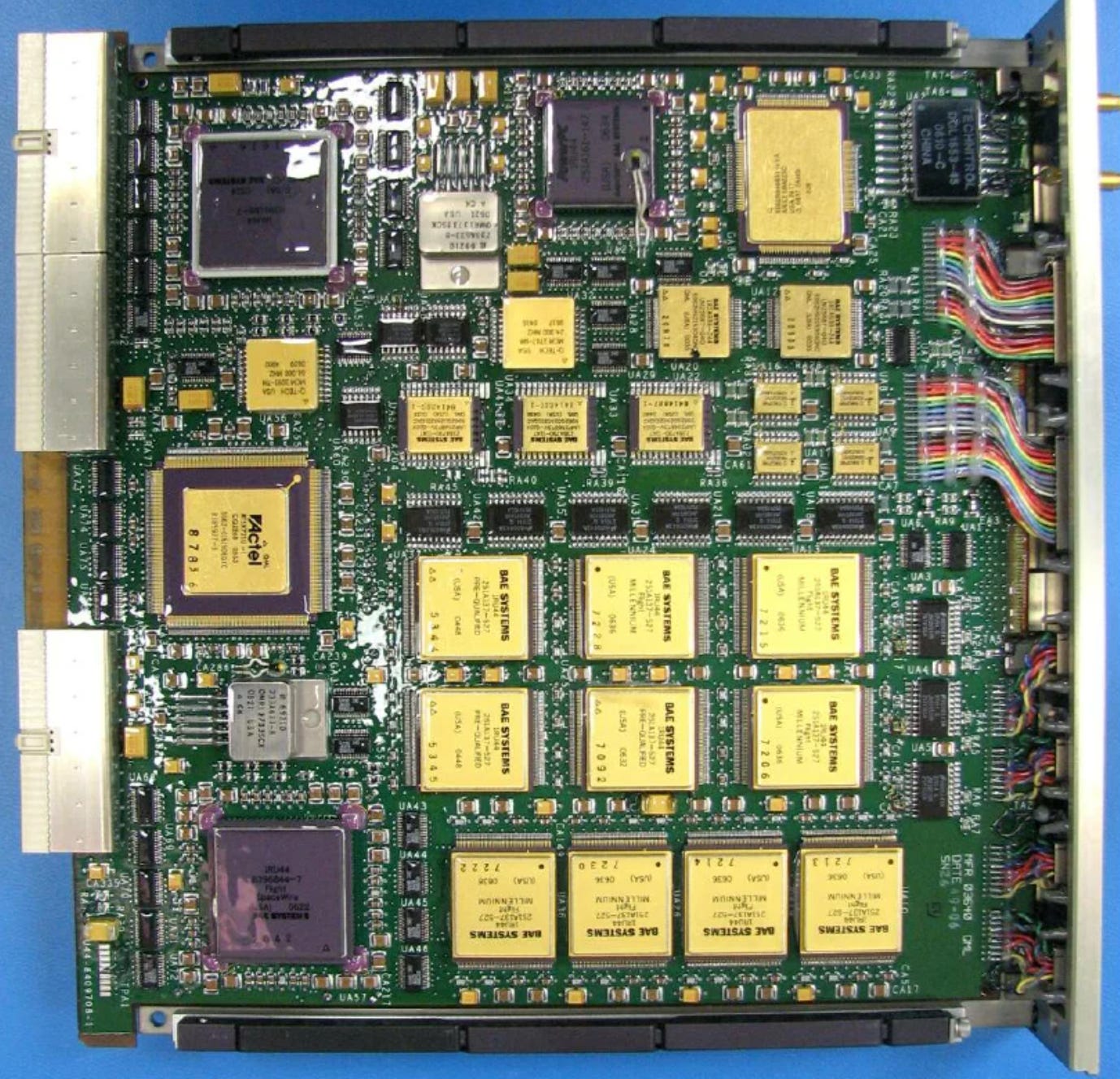
BAE RAD5545 is the modern successor: quad-core, 466 MHz, 35W, 100 krad tolerance. Capable enough for signal processing and moderate data analysis workloads.

FPGAs — The Flexible Middle Ground
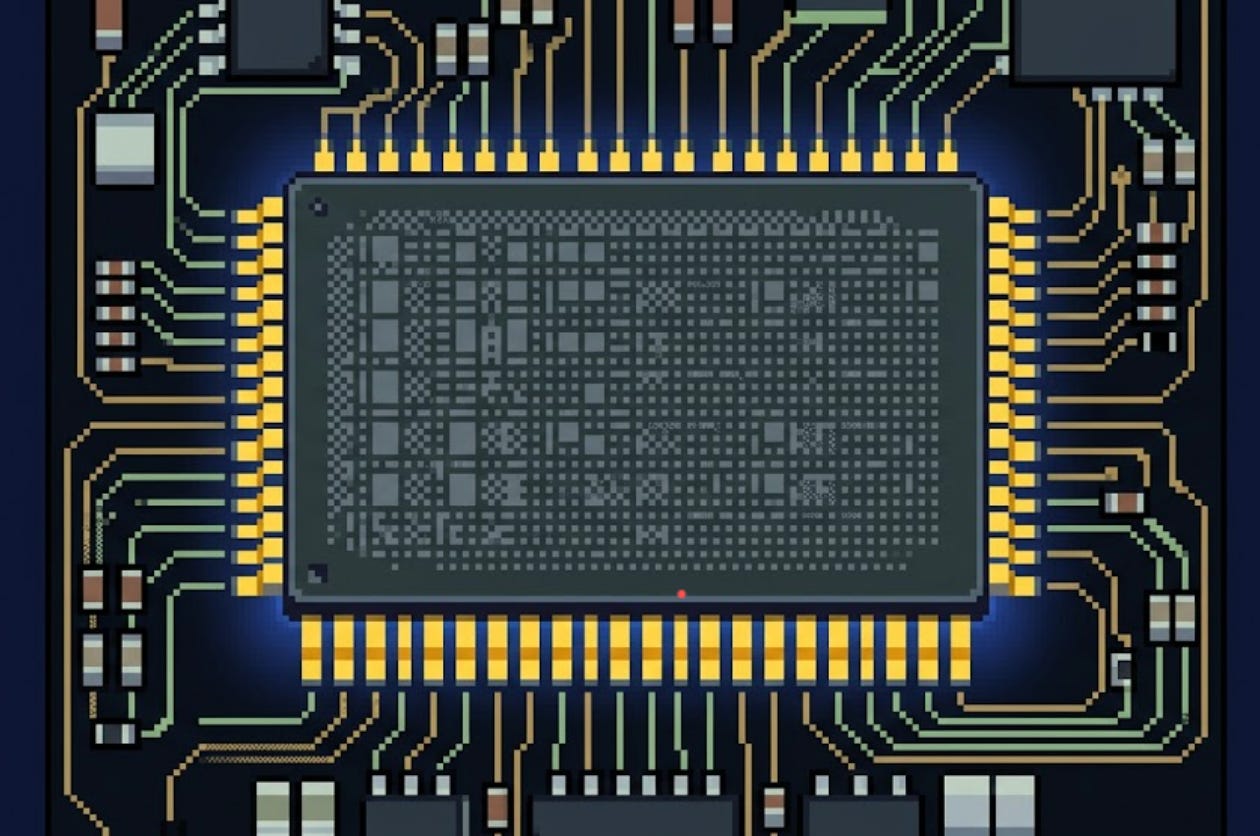
Field-Programmable Gate Arrays are reconfigurable chips that can be rewired in software after launch. They sit between fixed CPUs and full GPUs — more flexible than a CPU for signal processing, more power-efficient than a GPU for fixed-function tasks.
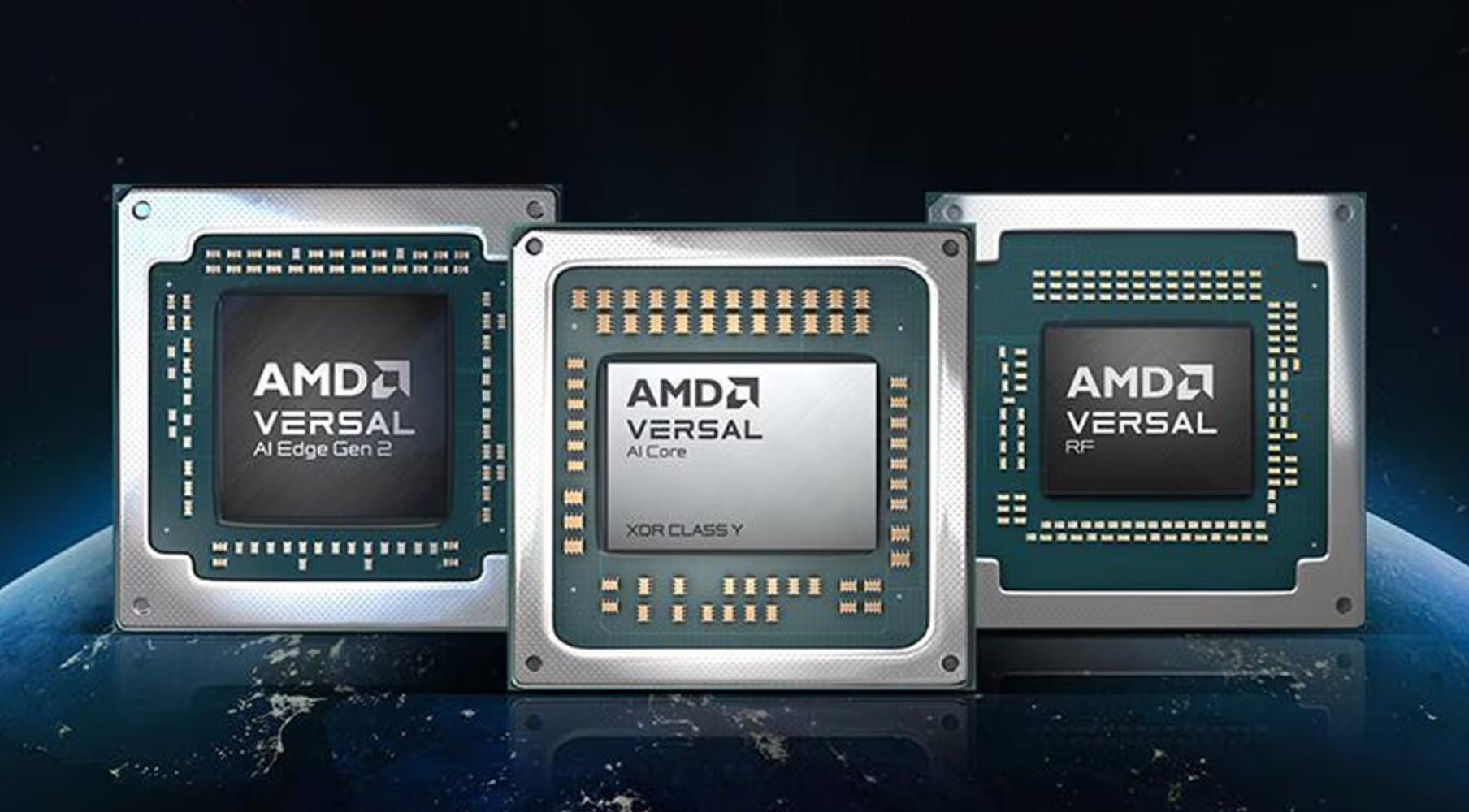
AMD/Xilinx Versal XQR space-grade FPGA: the most capable space-qualified FPGA available today, with integrated AI engines for ML inference. ~5–10W for typical workloads. Used for onboard image processing, AI inference pipelines, and custom algorithm acceleration.
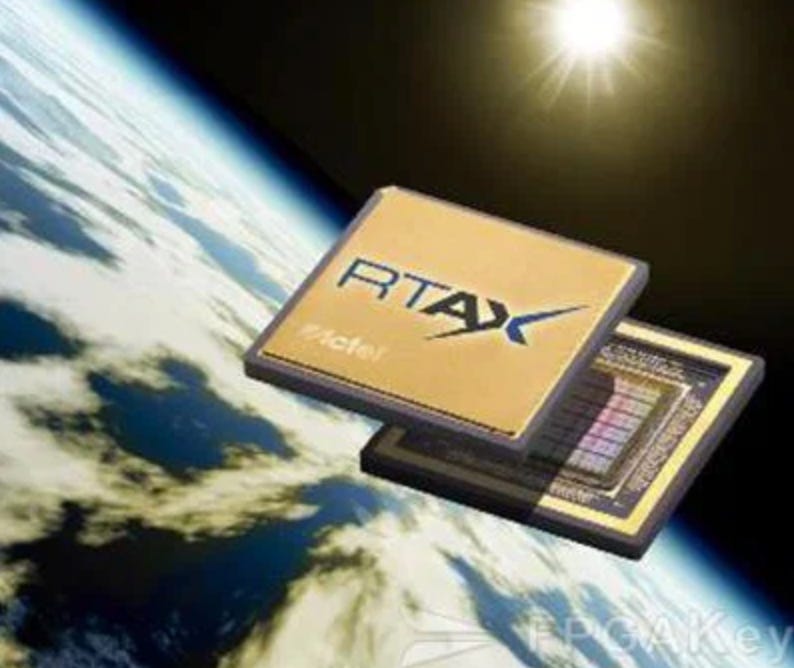
Microsemi RTAX-S: Built-in Triple Modular Redundancy (TMR) — three copies of every computation, majority-vote on the result. Immune to single-event upsets. ~1–5W. The conservative choice for deep-space missions where you can’t tolerate errors.
FPGAs are ideal for Tiers 1–4: cloud detection, compression, and classification at low power.
NVIDIA Jetson — COTS AI That’s Been to Space
Commercial off-the-shelf (COTS) AI modules weren’t designed for space — but they’ve been radiation-tested and are increasingly flying on LEO satellites where radiation doses are manageable.
Jetson Nano: 7–25W, 128-core Maxwell GPU, 472 GFLOPS FP16. Passed Total Ionizing Dose radiation testing beyond 20 krad(Si) — sufficient for 1–2 year LEO missions. Fits in a 3U CubeSat power budget. Entry point for real AI in small satellites.
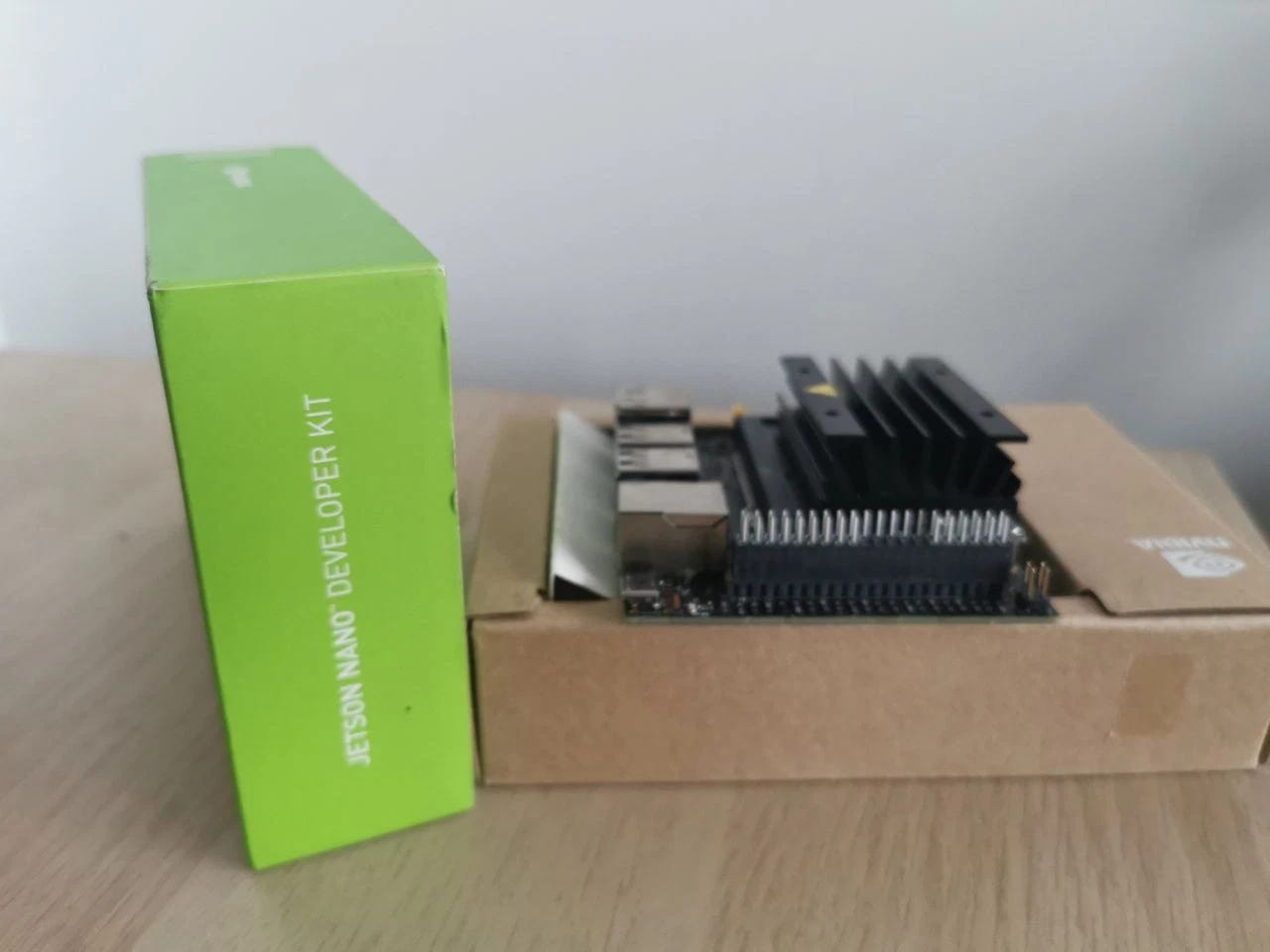
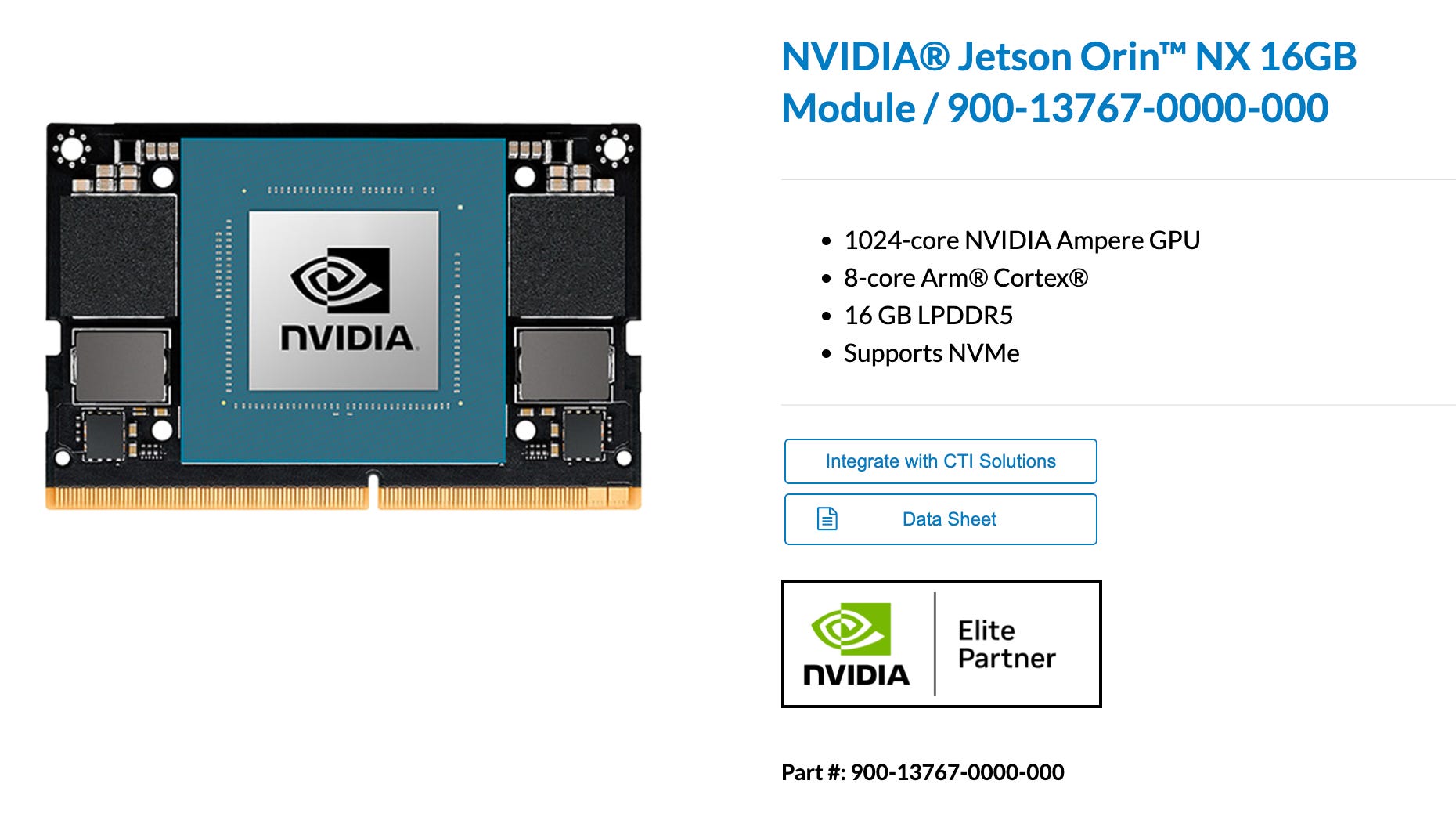
Jetson Orin NX: 10–25W, 157 TOPS AI performance, 5× improvement over Xavier NX. Radiation-tested for LEO. The current commercial sweet spot for 6U CubeSats and small satellites.
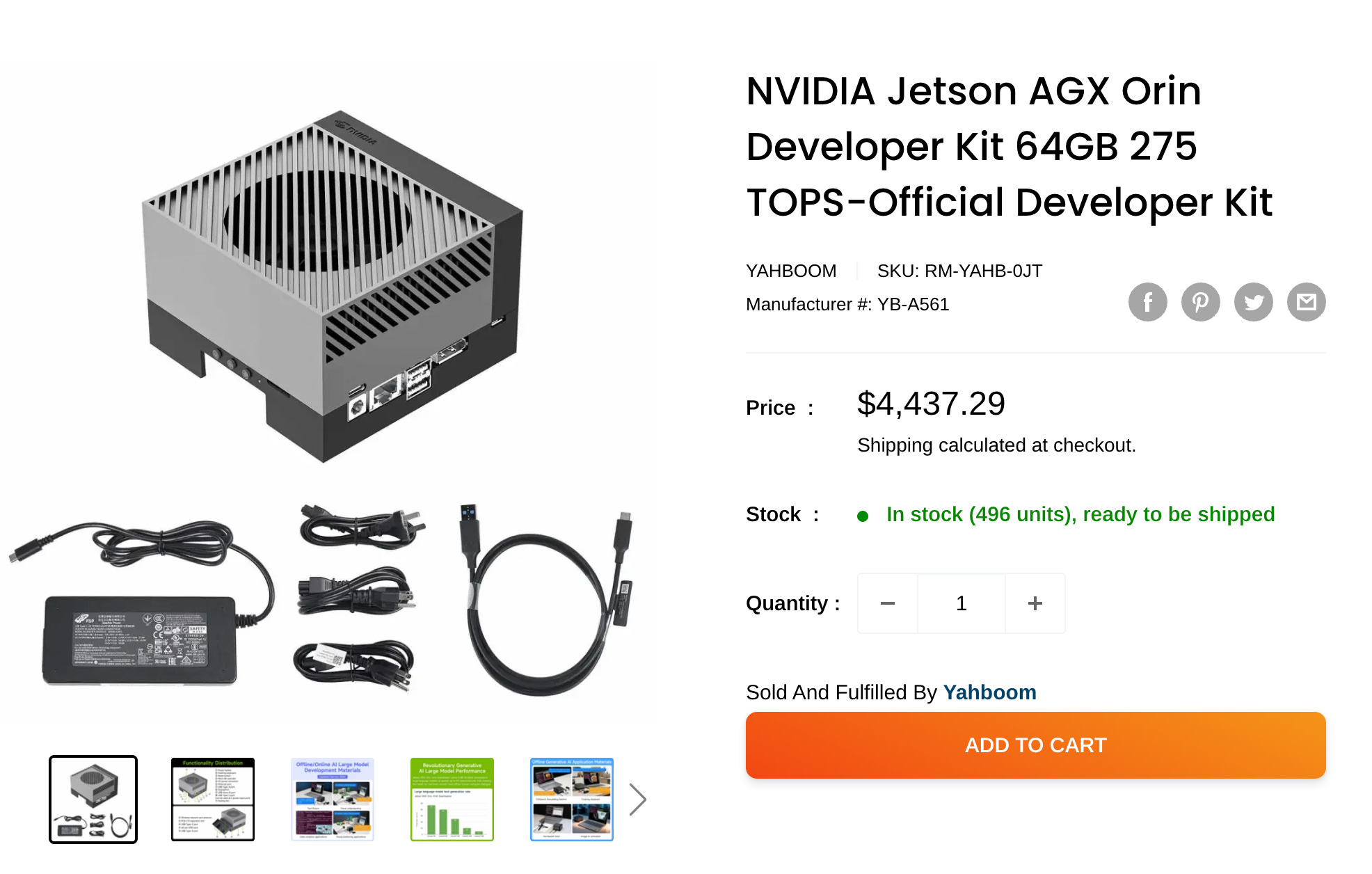
Jetson AGX Orin Industrial: 15–75W (configurable), 248 TOPS, 2048 CUDA cores, 12-core ARM CPU, up to 64 GB RAM. This is the serious workhorse — capable of full ML inference pipelines on smallsats.
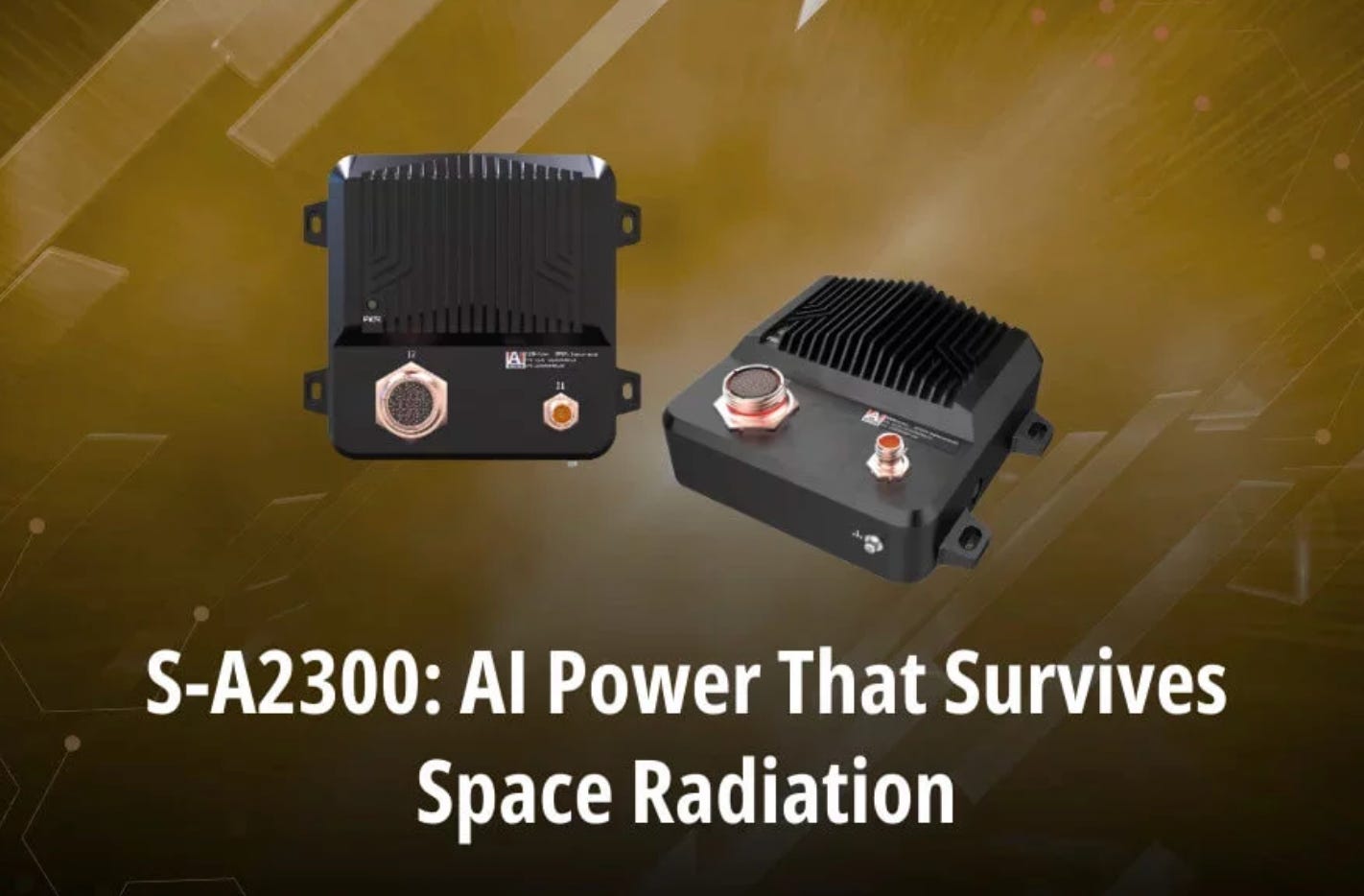
Aitech S-A2300 packages the AGX Orin Industrial into a radiation-characterized enclosure specifically for LEO satellite missions — the bridge between a consumer AI module and a space-grade system.
Google Coral Edge TPU — Tiny but Mighty
NASA‘s SC-LEARN (SpaceCube Low-power Edge AI Resilient Node) project integrated Google‘s Coral Edge TPU into a CubeSat-compatible card. The result: trillions of operations per second at just a few watts of power — a remarkable efficiency ratio that makes it ideal for 3U–6U satellites with tight power budgets.
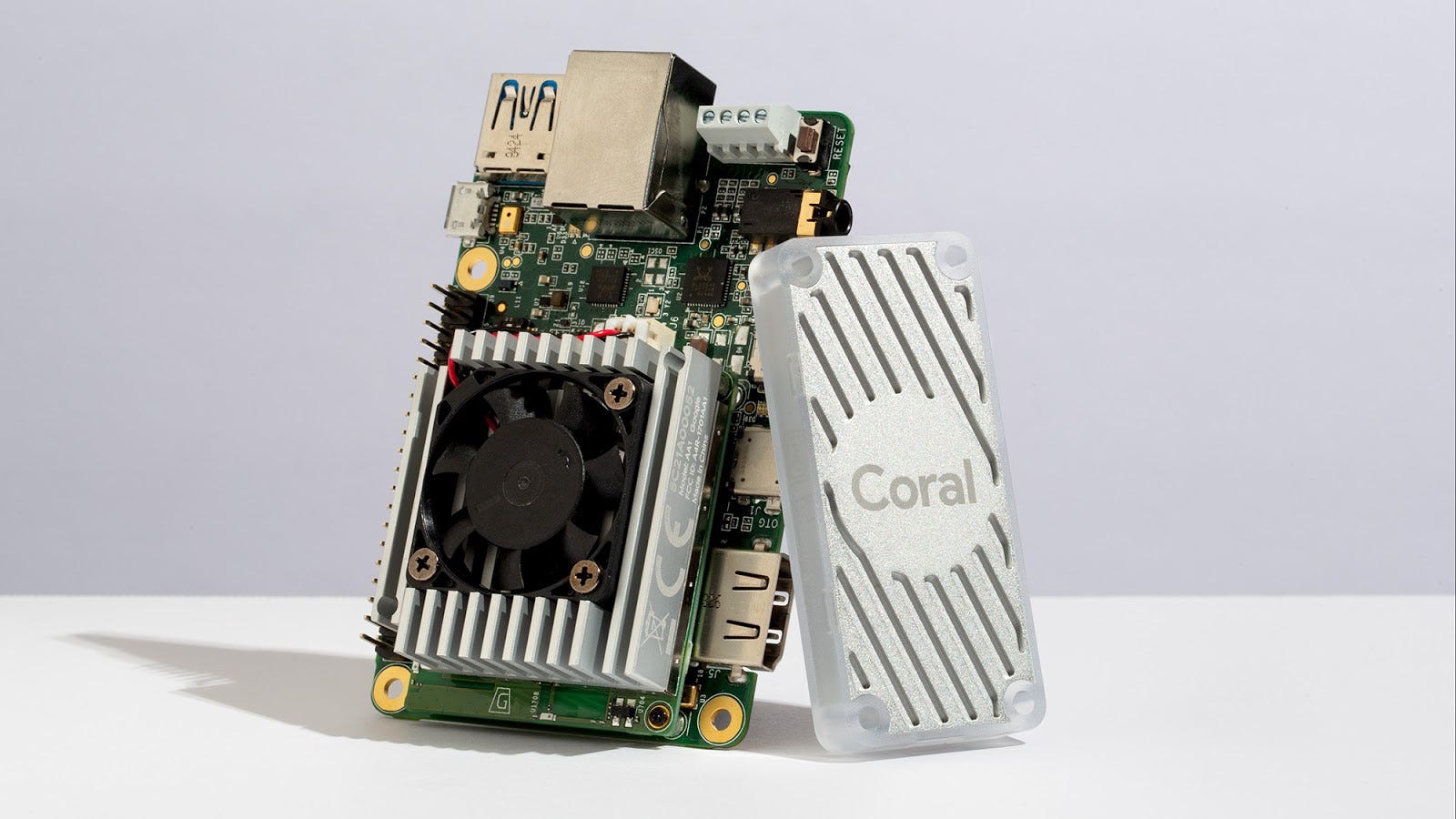
The Coral TPU excels at fixed-function inference: running a trained neural network at high speed and low power. It doesn’t train models — it executes them. Perfect for cloud detection, object classification, and anomaly detection in resource-constrained spacecraft.
NVIDIA H100 in Orbit — The Data Center Goes to Space
In 2026, Starcloud is launching a satellite hosting an NVIDIA H100 GPU cluster — the same chip powering hyperscale AI data centers on Earth, adapted for space with custom thermal management and power systems. At full terrestrial power, an H100 consumes 700W; the space version uses custom engineering to operate within satellite power budgets.
This isn’t a scientific instrument. It’s a commercial orbital compute node — a data center in LEO that customers can rent for AI workloads that benefit from being processed close to where the data is collected.
NVIDIA Space-1 Vera Rubin Module — The Orbital Data Center
The cutting edge of space compute. NVIDIA‘s Space-1 Vera Rubin Module combines two Rubin GPUs with one Vera CPU (88 NVIDIA-designed cores), delivering 25× more AI compute than the H100 for space-based inferencing, with 1.2 TB/s LPDDR5X memory bandwidth. It’s specifically engineered for size-, weight-, and power-constrained satellite environments.
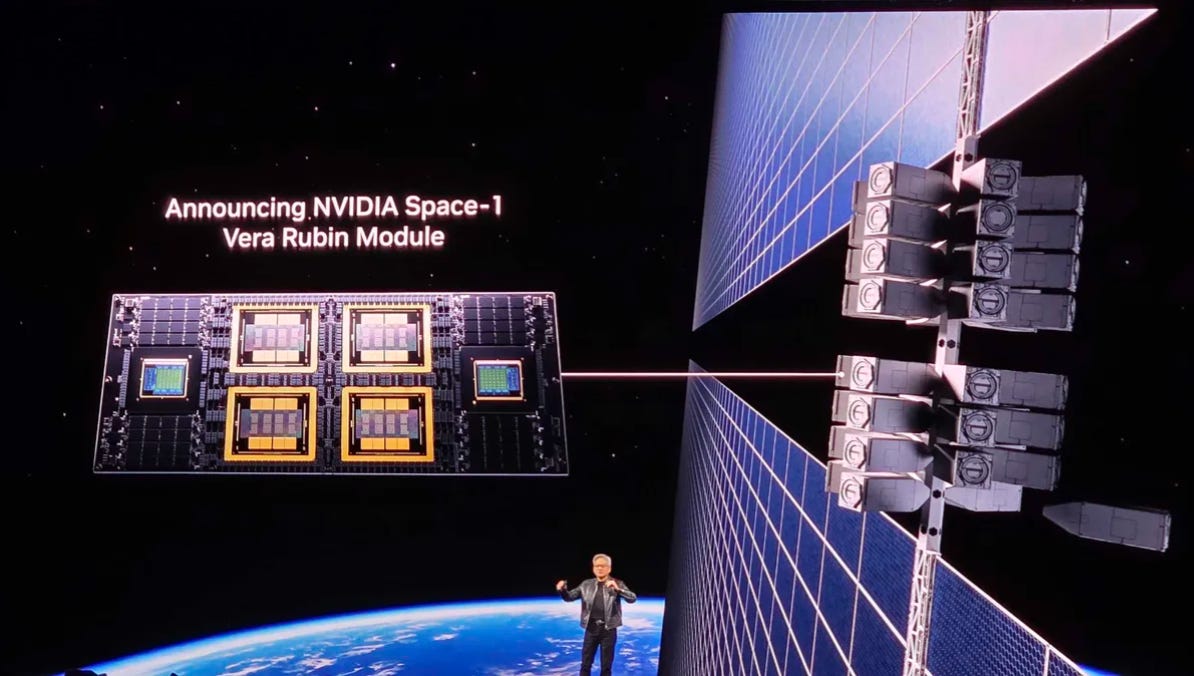
VAST Space has designed its 15 kW-class satellite bus to integrate the Vera Rubin Space-1 Module — creating an orbital data center capable of running large language models, foundation models for Earth intelligence, and full AI training pipelines in space. First VAST launch is planned for 2027.
This is the satellite equivalent of the jump from a pocket calculator to a supercomputer — happening in a single product generation.
Satellite Size vs. Compute: What Fits Where
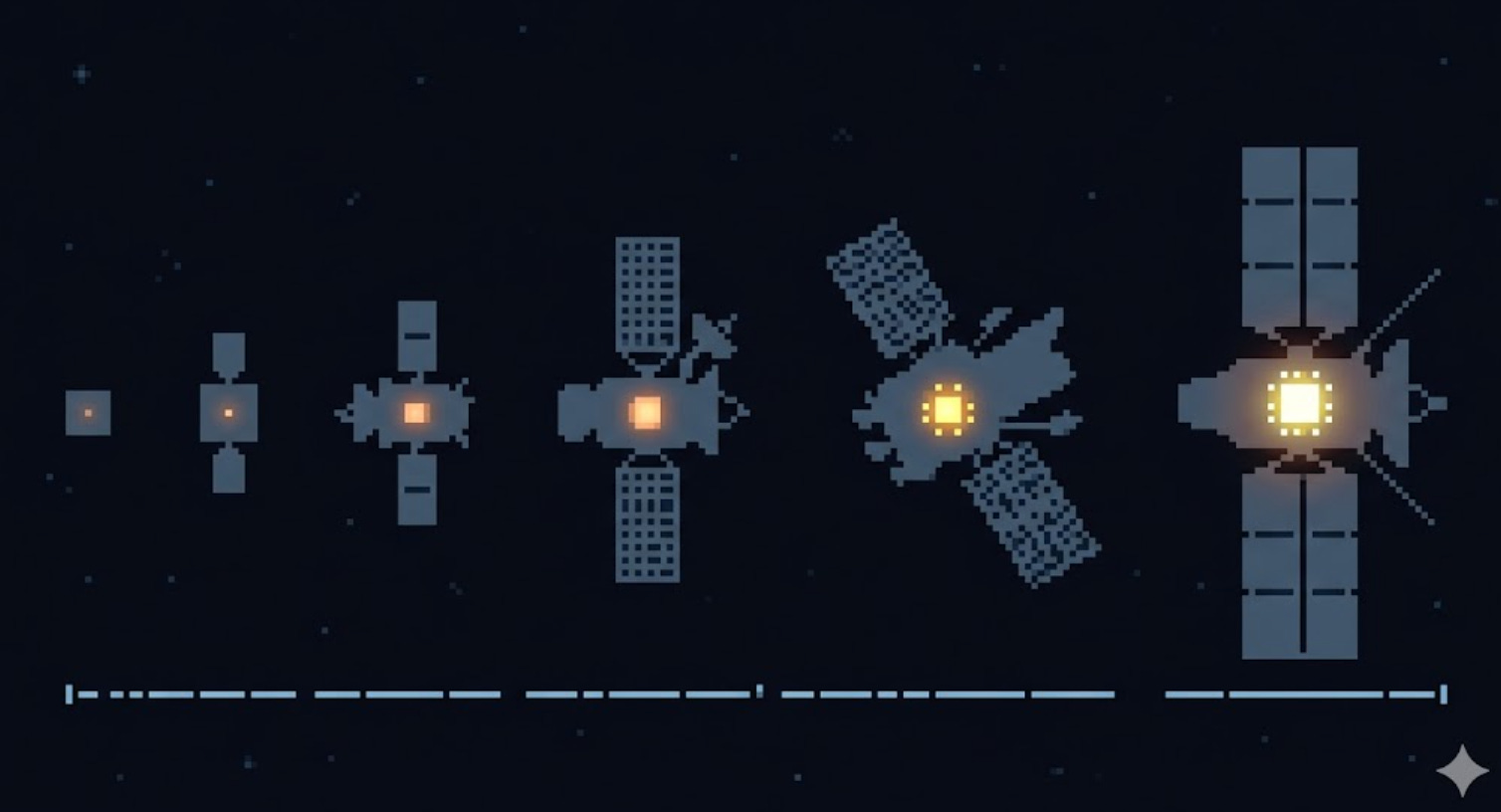
The satellite you need depends entirely on what compute you want to run. Here’s how the physics maps out:
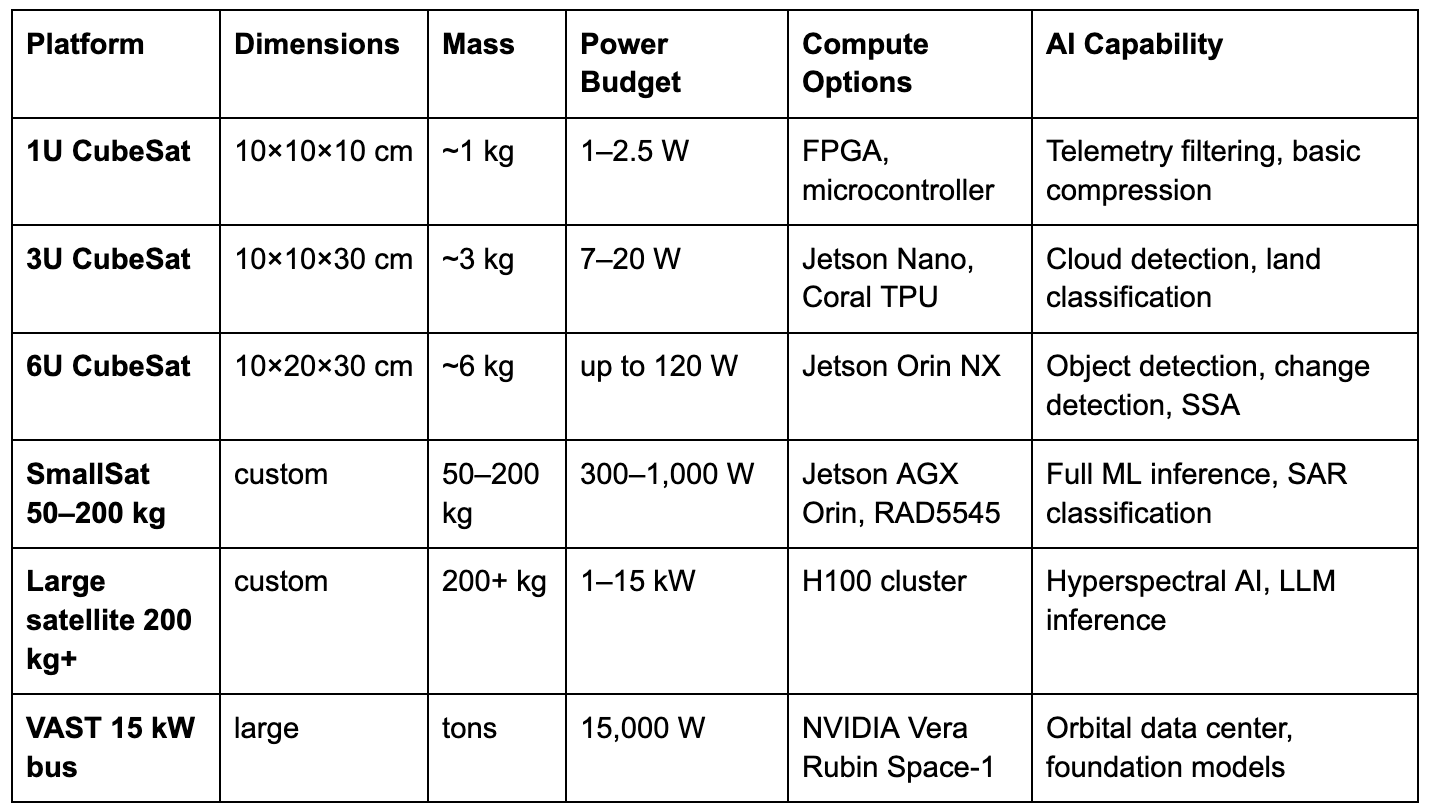
One important note: power budget is the hard constraint. For every watt of compute, you need roughly one watt of solar generation capacity and one watt of thermal rejection capacity. A Jetson AGX Orin running at 75W requires a satellite with a meaningful solar array area and dedicated radiator panels — that pushes you toward at least a 6U or larger platform.
The Three Hard Problems
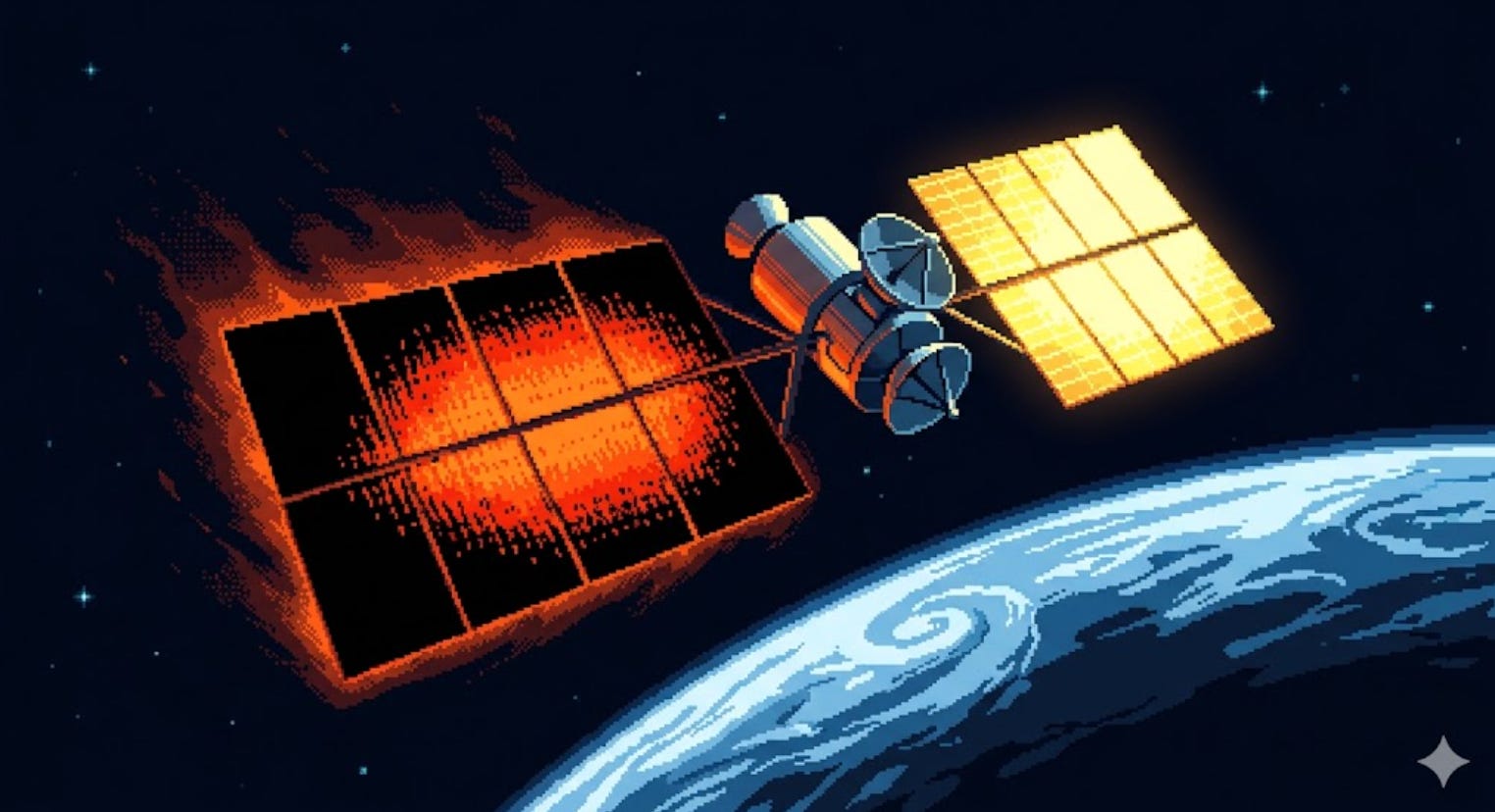
Running AI in space sounds straightforward. In practice, three fundamental physics problems make it genuinely difficult.
1. Radiation: The Silent Corruptor
Space is bathed in cosmic rays, solar protons, and trapped radiation in the Van Allen belts. When a high-energy particle passes through a transistor, it can flip a bit — a Single Event Upset (SEU). In a memory chip storing an image, one flipped bit produces a white pixel. In a neural network performing inference, one flipped bit in a weight matrix can silently corrupt the output — and you won’t know it happened.
Modern AI accelerators use sub-10nm transistors that are particularly vulnerable. The smaller the transistor, the less charge it holds, and the easier it is for a cosmic ray to flip it. Standard solutions:
Triple Modular Redundancy (TMR): Run every computation three times, take the majority vote. 3× power cost.
Error Correction Codes (ECC): Detect and correct single-bit errors in memory automatically.
Periodic scrubbing: For SRAM-based FPGAs, periodically rewrite configuration memory to correct accumulated bit flips.
Radiation-hardened fabrication: Special chip manufacturing processes that make transistors inherently more radiation-resistant. More expensive, less capable.
The Safe-NEureka architecture (a research project) uses a hybrid DMR/TMR approach specifically for deep neural networks in space — detecting when inference results may have been corrupted and triggering recomputation.
2. Thermal: No Air to Carry Heat Away
On Earth, chips cool themselves by heating the air around them. In space, there is no air. Heat can only leave a satellite by thermal radiation from surfaces — a far less efficient process. A satellite’s radiator panels (those flat, often black-painted surfaces you see on spacecraft) are the only mechanism for getting rid of waste heat.
For a small 3U CubeSat, the total radiating surface is a few hundred square centimeters. Running a Jetson Orin NX at 25W in that enclosure is a thermal engineering challenge. Thermal throttling — the processor slowing itself down to avoid overheating — is a real operational concern for onboard AI workloads. Large satellites solve this with dedicated deployable radiators, heat pipes, and active thermal control loops.
3. Power: The Eclipse Problem
Satellites in LEO spend roughly 35% of each 90-minute orbit in Earth’s shadow. During eclipse, solar panels generate nothing. All power comes from batteries. Running a demanding AI inference job during eclipse drains batteries faster, potentially leaving insufficient power for other critical systems.
This means onboard AI workloads must be scheduled around the power timeline — run heavy compute during sunlit periods, throttle back during eclipse, ensure battery reserves for communications and attitude control. Every AI workload has to earn its power budget against competing satellite functions.
Companies Leading the Way
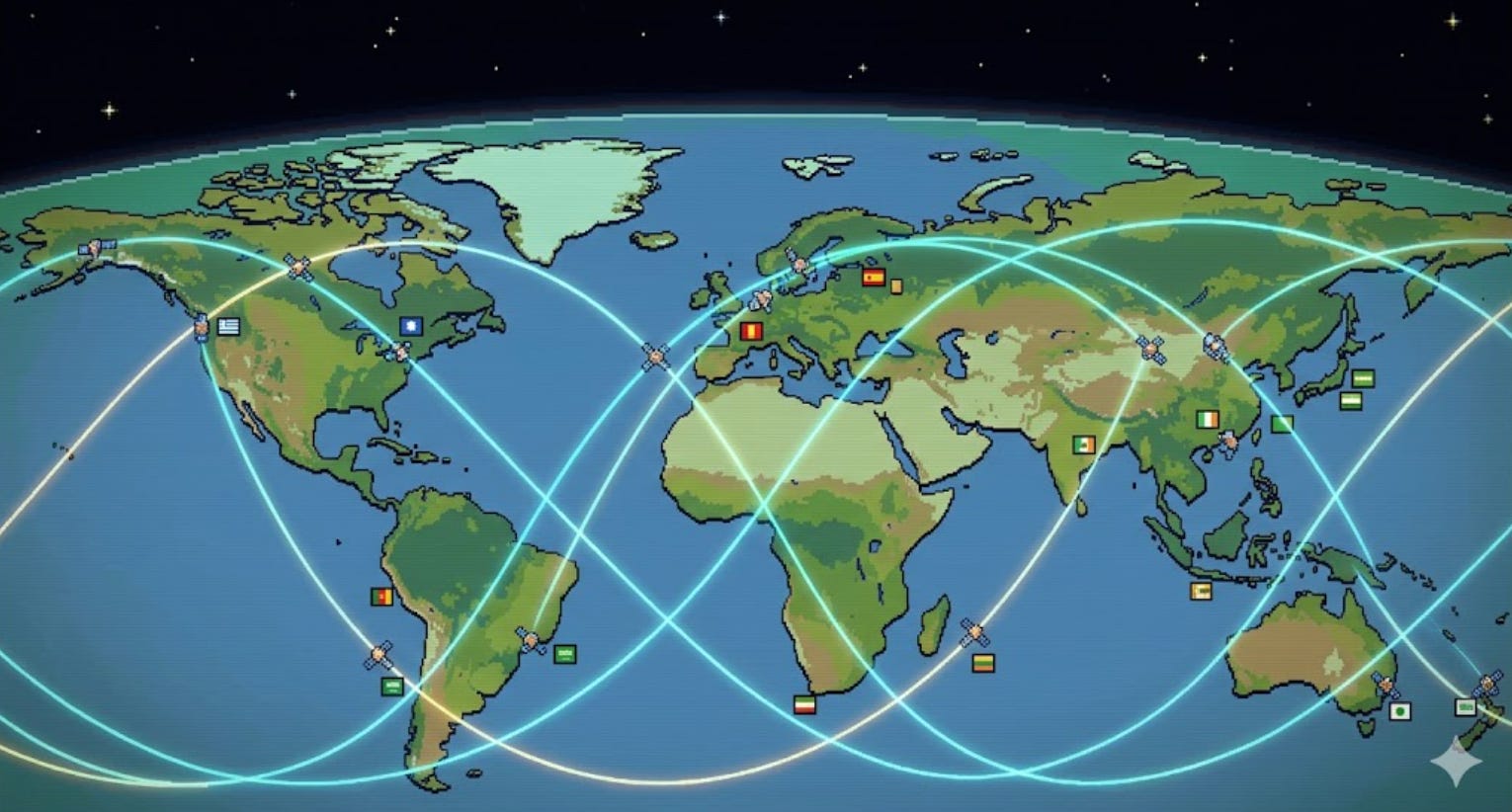
The on-orbit AI industry has moved from research papers to operational satellites in the span of five years. Here are the organizations at the frontier:
Satellogic holds the longest commercial heritage — 13 years of flying GPUs in space. Their next-generation Merlin constellation (projected launch October 2026) is an AI-first platform with onboard edge processing for real-time imagery analysis. They were awarded a $30M contract for AI-first constellation services, validating the commercial model.
Loft Orbital‘s YAM-9 (launched November 2025) was the first commercial satellite to host four networked compute units creating a heterogeneous processing environment onboard. Their “Virtual Missions” platform lets customers deploy and update AI models on the satellite after launch — treating the satellite like a software platform. They are planning the world’s first operational AI/edge-compute constellation, and have partnered with Helsing (defense AI) for a multi-sensor constellation for European defense and security.
Pixxel (India) is building the most ambitious near-term orbital compute capability: a 200 kg Pathfinder satellite (Q4 2026) carrying datacenter-grade GPUs, partnered with Sarvam AI to create India’s first orbital data center. Goal: real-time hyperspectral AI inference in orbit.
ICEYE (Finland/US) demonstrated practical defense AI: 30-second onboard SAR classification of military targets — from satellite tasking to labeled intelligence — a capability that transforms tactical reconnaissance.
D-Orbit partnered with SkyServe STORM for on-orbit ML inference and with AWS for the first demonstration of cloud ML services running on an orbiting satellite. Their ION platform is effectively a software-defined satellite bus with compute as a service.
VAST Space is building the most powerful orbital compute platform yet — a 15 kW bus designed to host NVIDIA’s Vera Rubin Space-1 Module, with a confidential anchor customer for 4 satellites and options for 200+ more. First launch: 2027.
Kepler Communications (Canada 🇨🇦) currently operates the largest active orbital compute cluster in existence. In March 2026, they commissioned distributed cloud infrastructure across their optical constellation — 40 NVIDIA Jetson Orin modules spread across 10 satellites in their “Aether” Tranche 1 series, linked by optical inter-satellite links (OISLs). Unlike most companies on this list, this is live and open for commercial AI workloads today, not projected. Kepler is also the only major player in this space headquartered in Canada.
Starcloud (YC-backed 🇺🇸) launched Starcloud-1 in November 2025 with an NVIDIA H100 GPU and ran the first LLM inference in space in December 2025. Their Starcloud-2 (2027) upgrades to Blackwell GPUs + AWS Outposts integration, and they have filed FCC paperwork for an 88,000-satellite constellation. The purest orbital data center company on this list — no Earth observation, no IoT, just compute-as-a-service from orbit.
Orbital (a16z-backed 🇺🇸) is launching Orbital-1 on a Falcon 9 in April 2027, carrying NVIDIA Vera Rubin Space-1 GPUs. Their model is specifically distributed AI inference — each satellite is a node in a parallel inference cluster, solar-powered and radiatively cooled. A direct competitor to VAST Space but focused purely on inference-as-a-service rather than general orbital data center operations.
Google (🇺🇸) is entering orbital AI through Project Suncatcher, a joint initiative with Planet Labs to launch two prototype satellites by early 2027. Crucially, Google is using TPU chips (not GPUs) — the same custom AI accelerators powering Google’s data centers on Earth. This is a significant architectural bet: TPUs offer better performance-per-watt for inference workloads but require Google’s software stack. CEO Sundar Pichai has publicly called orbital data centers “the new normal within a decade.”
SpaceX / SpaceXAI (🇺🇸) filed FCC paperwork for SpaceXAI — an orbital computing constellation of up to 1 million satellites with optical inter-satellite links, targeting 100 GW of AI compute capacity. Elon Musk’s acquisition of xAI further signals intent to combine the world’s largest satellite network (Starlink) with AI infrastructure at unprecedented scale. Timeline is years away, but the Starlink orbital infrastructure advantage and the stated ambition make this impossible to ignore as the long-term market shaper.
Zhejiang Lab / ADAspace (China 🇨🇳) launched the first 12 satellites of their “Three-Body Computing Constellation” in May 2025 and has already demonstrated in-orbit AI model deployment and inter-satellite networking. The full plan calls for 2,800 satellites delivering 1 quintillion operations per second — the most ambitious national-scale orbital compute program outside the US, and already partially operational. Named after Liu Cixin’s sci-fi novel, this is China’s direct answer to US orbital AI dominance.
Axiom Space (🇺🇸) is taking a unique approach — deploying an Orbital Data Center (ODC) Node on the ISS in partnership with Spacebilt, Skyloom (optical comms), Phison, and Microchip Technology. It provides AI/ML compute, cloud storage, and processing accessible to satellites in LEO and astronauts onboard. The only station-hosted compute node, serving a dual defense/commercial role — and a proof point that orbital compute doesn’t have to mean free-flying satellites.
The Future: What Comes Next

On-orbit AI is in its early innings. Here’s what the next decade looks like:
Autonomous satellite-to-satellite coordination. Constellations will develop peer-to-peer AI networks — satellites talking directly to each other via inter-satellite laser links, sharing workloads, distributing inference, and coordinating maneuvers without ground involvement.
On-orbit model training. Today’s satellites run inference on pre-trained models. Tomorrow’s will retrain and fine-tune models using new data collected in orbit — a continuously improving AI that gets smarter with every pass. Pixxel has explicitly stated this as a goal.
AI-guided in-orbit servicing. Robotic satellites will use AI vision and manipulation to autonomously rendezvous, dock, and service other satellites — refuelling them, replacing failed components, and upgrading obsolete hardware. Northrop Grumman’s MEV-1 already demonstrated docking; the next step is AI-autonomous servicing at scale.
Climate and methane monitoring. Real-time on-orbit AI for carbon/methane emission quantification from oil fields, pipelines, and industrial sites. Every barrel equivalent of leaked methane can be detected, attributed, and reported automatically — enabling real carbon accountability at a global scale.
Precision agriculture from orbit. AI-driven crop stress detection, yield prediction, irrigation guidance — downlinked not as images but as actionable farm management recommendations, generated onboard.
IoT edge intelligence. Even small LEO IoT satellites — not just large Earth-observation platforms — can run lightweight AI. A 6U CubeSat collecting telemetry from remote sensors can detect anomalies onboard and only alert the ground when something unusual happens, rather than streaming every data point.
Summary
The satellite is no longer just a sensor pointed at Earth — it’s becoming an intelligent platform that thinks, decides, and acts in orbit.
The progression is clear: from simple cloud filtering on a 3U CubeSat drawing 10 watts, to LLM inference on a 15 kW orbital data center. From detecting deforestation to predicting missile trajectories. From managing collision avoidance to tracking asteroids that could threaten Earth.
The key insight: the bottleneck in space is no longer getting hardware to orbit — launch costs have collapsed. The bottleneck is now intelligence on orbit. The satellites that win the next decade won’t be the ones with the best sensors. They’ll be the ones with the best AI.
Hardware on orbit × Intelligence on orbit = the commercial space economy.